|
.png)
Gloria Petyarre
Biography:
 Gloria Petyarre was one of Australia’s most successful and significant female
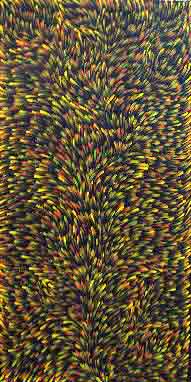
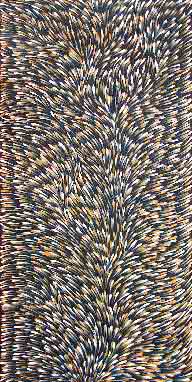
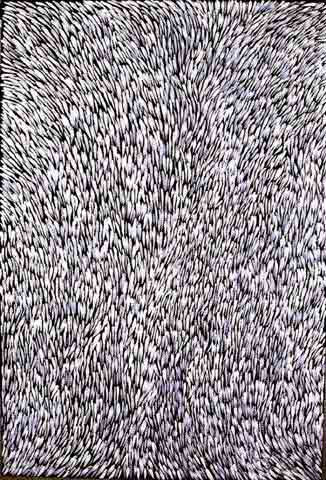
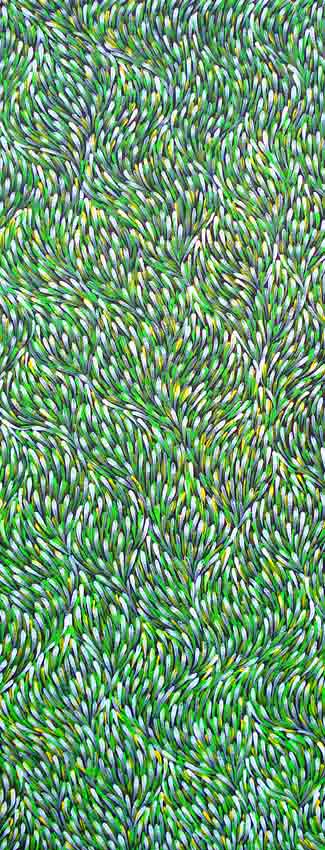
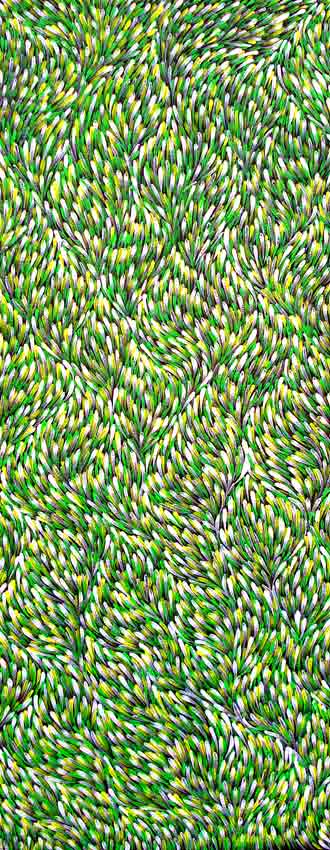
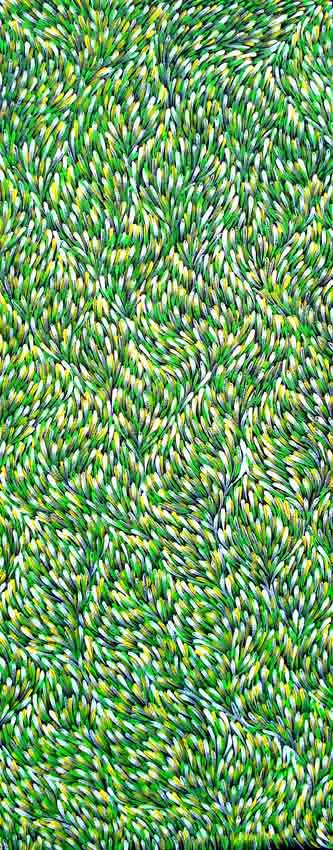
artists. Her depiction of the Kurrajong bush medicine leaves with her layered,
free-flowing, swirling brushstrokes that scatter across the canvas became her
iconic motif. Gloria Petyarre was one of Australia’s most successful and significant female
artists. Her depiction of the Kurrajong bush medicine leaves with her layered,
free-flowing, swirling brushstrokes that scatter across the canvas became her
iconic motif.
It is a significant loss to the art world and those who knew her personally or
through her paintings.
Our thoughts are with Ms Petyarre’s family and community, who are grieving the
loss of this incomparable woman.
Geoff Henderson
AAAA President
Sorry Business
Gloria Petyarre passed away on 8 June 2021. The world seems a little less bright
after learning of the passing of the incomparable Gloria Petyarre on 8 June
2021.
Gloria Petyarre was one of Australia’s most successful and significant female
artists and this news is a great loss to the art world and those people who knew
her personally or through her paintings.
How did a woman raised in a remote part of the Eastern Desert and instructed in
Anmatyerre law and traditions capture the hearts of art lovers around the world?
Petyarre participated in the first art programs organized at Utopia in 1977.
The batik-making workshops marked the emergence of Aboriginal women artists,
and from the outset Petyarre’s richly colourful works were informed by the
natural shapes and patterns of local leaves, flowers, seeds and grasses. They
reflected the daily interaction of desert women with their environment.
When acrylic paints and canvas were introduced in the 1980’s her talent was
immediately apparent. Working alongside Emily Kame Kngwarreye and inspired by
the older woman’s groundbreaking success and brave, expressive abstraction,
Gloria excitedly began to experiment and freely. She tapped into her own
experiences to produce a confident and distinctive style.
In 1999, Petyarre burst onto the Australian art scene in a big way when she won
the prestigious Wynne Prize for Landscape. She was the first Indigenous
Australian to win a major non-Indigenous art prize, cementing her name in art
history.
Gloria continued to become a worldwide success with her unique subject matter
and remarkable ability to depict her ancient dreaming stories in a highly
contemporary and expressive manner. Her depiction of the Kurrajong bush medicine
leaves—with her layered, free-flowing, swirling brushstrokes that scatter across
the canvas—became her iconic motif.
An artist of great versatility, Petyarre experimented with her iconic subject
matter, producing what is known as her ‘Big Leaf’ paintings, as well as her
Thorny Mountain Devil Lizard, Yam and Grass Seed Dreaming.
Gloria
Petyarre
work
is high
demand sought after by Australian and international collectors.
Gloria Petyarre
Bush
Medicine
painting Sotheby's sold for $78,000
Gloria and her sisters inherited the Mountain Devil Lizard (Arnkerrth) Dreaming
from their paternal grandmother. Custodians of this significant Dreaming story,
it is their duty to maintain it and pass it on to future generations. This
Aboriginal mythology story tells of the ancestor Mountain Devil Lizard, an old
woman who travelled the vast regions of the Atnangker country defining the
landscape and identifying the sacred sites. It is believed the lizard collected
then deposited ochre colours throughout the Atnangkere country, Utopia, where
the women used these colours for body painting in their traditional ceremonies.
Gloria Petyarre
was
born at Atnangkere
Soakage is an
Australian Aboriginal
artist from the
Anmatyerre community who live just north of
Alice Springs.
Gloria
won Australia's longest running art prize, the
Wynne Prize in 1999 with Leaves, being the
first Aboriginal person to win one of the
Art Gallery of New South Wales's major prizes.
She travelled to
Ireland,
England and
India in 1990 as part of the Utopia – A
picture story exhibition. She held her first solo exhibition in 1991.
Gloria
is represented
in major Australian galleries such as the
National Gallery of Australia. She is the
niece of
Emily Kngwarreye and the younger sister of
Kathleen Petyarre, two of the greatest
Aboriginal artists.
Gloria Petyarre
lived at the
Utopia community after 1977, where she started
batik painting, exhibiting in shows around Australia for ten years. She
began work on the 'Summer Project' in 1989 which involved translating
the batik paintings onto canvas.
Gloria
was one of the
founding members of this Utopia Women's Batik Group. Gloria paints
several
Dreamtime stories such as Pencil
Yam,
Bean,
Emu and Mountain Devil Lizard and Small Brown
Grass. Several of Gloria's sisters are also artists, the most notable
being
Kathleen Petyarre.
From Wikipedia, the free encyclopedia.
Gloria
Petyarre
won Australia's longest
running art prize, the
Wynne Prize in 1999 with Leaves, being the first Aboriginal
person to win one of the
Art Gallery of New South Wales's major prizes
2004 Wynne Landscape
Prize, Gallery of NSW, Sydney; 1999 Wynne Landscape Prize, Gallery of
NSW, Sydney.
Gloria is a one of the most prestigious artists and dynamic force in Australian art.
Gloria Petyarre
creative development comes from a very potent dreamtime stories and
virtuous experimentation facilitated her paintings to convey her peoples
affinity with the land. Her paintings harness an existential exuberance,
dynamism and brilliance, prompting scholars to affiliate them with
paintings by the Abstract Expressionist. Acknowledged by the Art
intelligentsia of Australia, in 1999 and 2004 Gloria Petyarre was
awarded the prestigious Australian landscape prize
The Wynn presented by The
Art Gallery of NSW, Sydney.
Gloria Petyarre
is the first
Aboriginal artist who won the most prestigious
Wynne Landscape
Art Award
with
Bush Medicine
painting and she won twice in
Art Gallery of New South Wales.
Biography is in Australian Encyclopedia Aboriginal Artists dictionary of
biographies page 258.
Gloria
Petyarre was the first Aboriginal
origin artist to win the most prestigious
Art Gallery of New South Wales
major prizes with
painting
'Bush
Medicine'.
2004 and
1999 Gloria
Petyarre
won
Wynne Landscape
Art
Prize
Award 'Bush Medicine
Leaves' Gallery of New South
Wales,
Wynne Prize
is
Australia's longest
running Art Prize.
1994
Gloria won 'Tapestry Commission' for the Law Courts in Brisbane,
1993 'Tapestry' for Victorian Tapestry
Workshop in Melbourne, and in 1993 'Mural' for Kansas City in USA.
Gloria
Petyarre work is represented in Australian National galleries and collections around the world
National Gallery of Australia,
Art Gallery of
New South Wales,
Art Bank,
Art
Gallery South Australia,
National
Gallery Victoria,
Art Gallery of Western Australia,
Queensland Art Gallery,
Homes
a Court Collection,
Powerhouse Museum,
Museum and Art Gallery of the Northern Territory,
Kerry Stokes Collection,
Homes a Court
Collection,
Gold Coast City Art Gallery Surfers Paradise.
Gloria Petyarre work
has
the
physical presence
of the much contemporary work of art.
Gloria
paintings are
enthralling and hypnotic,
made up of fine dots and dashes, muted tones the intricate details
and subtle shades,
seems to moves with the viewer’s eyes
and floats in the air, building up a mysterious multi-dimensional
sensation. Gloria ‘Bush Medicine’ landscapes are captivating, seem
to appear and disappear with the shifting winds and
changing colours of blowing leaves.
 Awards Awards
2004 Wynne Landscape Prize,
Art Gallery of New South Wales,
Sydney
1999
Wynne
Landscape Prize,
Art Gallery of New South Wales,
Sydney
1994
Tapestry Commission for the Law Courts,
Brisbane, Queensland
1993 Tapestry for Victorian Tapestry
Workshop, Melbourne, Victoria
1993 Mural for Kansas City Zoo, USA
COLLECTIONS
National Gallery of Australia, Canberra
Art Gallery of
New South Wales, Sydney
Art Bank, Sydney
Art
Gallery South Australia, Adelaide
National
Gallery Victoria, Melbourne
Art Gallery of Western Australia, Perth
Queensland Art Gallery, Brisbane
Homes
a Court Collection
Powerhouse Museum
Museum & Art Gallery of Northern Territory, Darwin
Kerry Stokes collection
Gold Coast City Art Gallery, Surfers Paradise QLD
Selected Major
Exhibitions
1988 2002
Utopia Art Sydney
1988
Bloomfield Gallery, Sydney
1998
Araluen Arts Centre, Alice Springs
1989
Austral Gallery, St Louis, U.S.A.
1989
Coventry Gallery, Sydney
1989
Utopia Art Sydney
1990
Tandanya, Adelaide
1990
Utopia
Art Sydney
1990
"Utopia", exhibited in Ireland, U.K.,
India
1990
Orange Regional Gallery
1990
Third Eye Centre, Glasgow
1991
Utopia Art Sydney
1991
1996 S.H. Ervin Gallery, Sydney
1991 Meat
Market Gallery, Melbourne
1991 &
1994, 1995, Art Gallery of NSW
1991
Australia Galleries, New York, USA
1992,
1994, 1995, 1999 Gallery Gabrielle
Pizzi, Melbourne
1992
Utopia
Art Sydney
1992
Robert Homes a Court Collection,
Bangkok, Thailand
1992 Gallery
Rai, Tokyo, Japan
1992,
1994, 1996, 2000, 2002 Royal Exhibition
Hall, Melbourne
1992
National Gallery of Australia, Canberra
1993 Myra
Morgan Gallery, Kansas, USA
1993
Utopia Art Sydney
1993 Art
Gallery of Queensland, Brisbane
1993
Austral Gallery, St Louis, USA
1993
Australian Embassy, Paris, France
1994
Utopia
Art Sydney
1995
National Gallery of Australia - Canberra
Museum of Art, Gifu, Japan
1995
National Gallery of Victoria, Melbourne
1995
Mitchell Galleries, State Library of
NSW
1995
Utopia
Art Sydney
1995
Powerhouse Museum, Sydney
1996
Niagara Galleries, Melbourne
1996,
2000 Old Parliament House, Canberra
1996
Utopia
Art Sydney
1996 &
1999 Sherman Galleries, Sydney
1996
William Mora Galleries, Melbourne
1997
Sutton Gallery, Melbourne
1997
Australian Galleries, Sydney
1998
Annandale Galleries, Sydney
1998
Utopia
Art Sydney
1999 Art
Gallery of Western Australia
1999
Embassy of Australia, Washington, USA
1999 Fine
Arts Museums of San Francisco, USA
1999
Utopia Art Sydney
2000
Fireworks Gallery, Brisbane
2000
Australian National University, Canberra
2000
Utopia
Art Sydney
2001
Brisbane City Gallery
2001
Manawatu Gallery, New Zealand
2001
Kunst der Gegenwart, Vienna, Austria
2001
"Icons of Australian Aboriginal Art",
Singapore
2001
Utopia Art Sydney
2002
Singapore Art Museum
2002
Light Square Gallery, Adelaide
2002 &
2003 National Gallery of Victoria at
Federation Square, Melbourne
2002 &
2003 Chapel off Chapel, Melbourne
2002
Utopia
Art Sydney
2003 Glen
Eira City Gallery, Melbourne
Bush
Medicine Leaves
Bush Medicine leaves
story relates to a native tree which grows abundantly in Gloria Petyarre homeland, the desert regions of Utopia, North-east of Alice Springs. The leaves are
valuable and important to the people of Utopia due to their health-giving properties.
W omen
gather the green leaves
and ground them with a stone. When mixed
with water this forms a milky solution, which can be used to cure coughs, colds
and flu-like symptoms.
The leaves are also used to make a paste that is applied to the skin to cure
boils, scabies and to wash with. This mixture can also cure aching joints and
when is placed on the temples it cures headaches.
Bush Medicine Leaves story has been passed down over thousands of years
and many generations. It is still being used today by the people in
Utopia and the eastern desert.
Gloria Petyarre "Bush Medicine"
painting is
Dreaming that depicts
the rushing movement of leaves with terse rhythmic brush
strokes has been heralded as one of her most successful stylistic
developments to date.
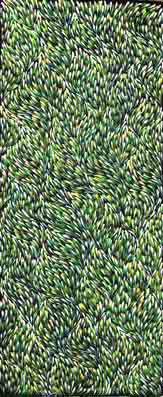
Gloria utilizes close tonal values of color
together with the rhythmic patterning of her brush strokes to imply the
movement of a tree's leaves as seen blowing in the wind. The leaves of
this tree are an important form of bush medicine, which are gathered by
women.
"Bush Medicine"
paintings symbolize an abundance of leaves blowing in the wind. The
leaves are from the flowering shrub called “medicine bush”.
Bush Medicine
leaves
are treated as a remedy and are used to make medicine to heal any skin
complaint including hives, inflammation, irritation spots and cuts,
wounds, bites and rashes.
It can also be used as an insect repellent.
From the medicine bush, women collect the leaves as well as the flowers,
the leaves are boiled to extract the resin. The resin of the leaves is
mixed with kangaroo fat to make a medicine paste. The flowers are lovely
and sweet to eat fresh.
Auction
Results
Related works
|
Image |
Details |
Price excl. GST |
| |
|
|
|
 |
Bush Medicine 2004
Synthetic polymer paint on canvas, 164 x 354 cm, Lawson~Menzies
(Menzies), Australian Aboriginal Art, Sydney, Lot No. 58; Provenance:
Dacou Gallery: Private Collection, SA |
$78,000 |
| |
|
|
|
 |
Awelye
Synthetic polymer paint on canvas, bears dimensions, 'R.M. Gooch Alice
Springs, Northern Territory, Australia', catalogue number #A897,and
'Awelye Mosquito Bore' on the reverse, 185 x 465 cm, Bonhams, Aboriginal
Art, Sydney, Lot No. 38 |
$36,000 |
| |
|
|
|
 |
Leaves 1998
Synthetic polymer paint on canvas, (1998, Mosquito bore, Utopia NT), 185
x 420 cm Sotheby's, Aboriginal Art, Melbourne, Lot No. 243; Marlu stamp
and Utopia Art label. Provenance: Executed at Mosquito Bore,
Utopia in November 1998. Marlu productions, Alice Springs. Utopia Art,
Sydney. Private collection Sydney |
$34,575 |
| |
|
|
 |
Ahnkerrthe 2000
Synthetic polymer paint on linen, 176 x 178 cm, Joel Fine Art, Important
Aboriginal Art, Melbourne, Lot No. 55 |
$30,176 |
| |
|
|
|
 |
Bush Leaves, 2004
Synthetic polymer paint on linen, 203 x 122 cm, Lawson~Menzies
(Menzies), Aboriginal Art, Sydney, Lot No. 219; Provenance: Red
Sand Art Gallery: Cat. no. PG77. Private Collection, SA |
$26,400 |
| |
|
|
|
 |
Leafs
Synthetic polymer paint on canvas, 187 x 105 cm, Christies, Australian
Aboriginal Art, Melbourne, Lot No. 61, Painted 2001, Utopia Art
certificate of authenticity, Sydney.
Provenance: Commissioned by Rodney Gooch, Alice Springs. Utopia
Art Sydney, Sydney. Private collection, Melbourne |
$25,095 |
| |
|
|
|
 |
Mountain Devil, 1999
Synthetic polymer paint on linen, 70 x 56 cm x 10, Lawson~Menzies
(Menzies), Aboriginal Art, Sydney, Lot No. 100, Provenance: Dacou
Gallery SA; Private Collection, SA |
$22,800 |
| |
|
|
|
 |
Bush Medicine, 2006
Synthetic polymer paint on linen, 121 x 150 cm, Lawson~Menzies
(Menzies), Aboriginal Art, Sydney, 22/11/2006, Lot No. 119; Provenance:
Dacou Gallery: Cat. no. DG06936. Private Collection, SA |
$19,200 |
| |
|
|
|
 |
Mountain Devil Lizard Dreaming, 2005
Acrylic on canvas, 115 x 212 cm, Cornette de Saint Cyr, Contemporary
Australian Aboriginal Art - The Collection of Arnaud Serval, Paris,
Lot No. 15; Provenance:
Acquired directly from the artist. |
€12,090 ($16,156) |

RETURN TOP
|