If you LOVE quality
Art of
impeccable
provenance,
the
art
you want is at
Galeria Aniela
|
|
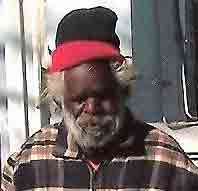
Charlie Tjapangati was born 1949, he is is
a renown
Australian artist
and one of the leading artists within the
Papunya Tula Artists
cooperative.
He began painting for
Papunya Tula Artists
in 1978.
In 1981 Charlie Tjapangati
exhibited with
Billy Stockman
in USA
'Mr. Sandman bring me a Dream'.
In 2000 Tjapangati was commissioned with four additional artists to complete a
painting at
Art Gallery of NSW.
Charlie
Tjapangati
work is
held in major
collections
including
Kelton
Foundation USA,
Art Gallery of NSW,
Art Gallery of South
Australia,
Queensland Art Gallery,
Australian Art Gallery,
National Gallery of Australia,
Museum and Art Gallery of the Northern
Territory,
National Gallery of Victoria,
Art Gallery of Western Australia,
Tasmanian Museum and National Art
Gallery. |
|
|
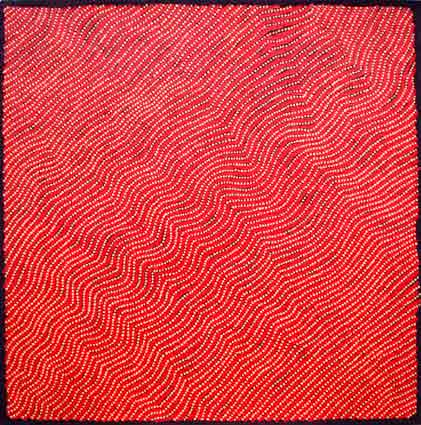
Charlie Tjapangati
Tingari Business CT0702
(2005)
Synthetic Polymer Paint on Belgian linen
Size:
95 cm x 95 cm
PRICE:
Enquire
shipping
worldwide
Provenance:
Mason Gallery Aboriginal Art
Related Works |
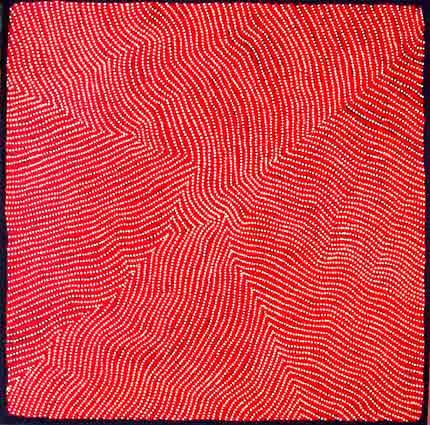
Charlie Tjapangati
Tingari Business CT0703
(2005)
Synthetic Polymer Paint on Belgian linen
Size:
95 cm x 95 cm
PRICE:
Enquire
shipping
worldwide
Provenance:
Mason Gallery Aboriginal Art
Related Works |
|
|
|
AUCTION RESULTS
Under freedom of information we compiled the relevant facts for you to enjoy.
We believe in sharing the knowledge. We express deep gratitude to everyone for
information, without them our research would not be available.
Charlie Tjapangati work has been sold at auction - please see the details below.
|
|
Details |
Price excl. GST |
|
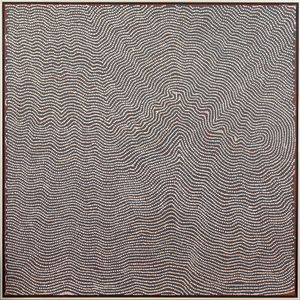 |
Untitled, 2002
Synthetic polymer paint on linen, inscribed verso with artist's name,
dimensions and,
122 x 122 cm, Est: $6,000-8,000, Bonhams, Important
Australian Art; 100 Works From Gene and Brian Sherman's Collection,
Sydney, 11/05/2022, Lot No. 54
|
$14,760 |
|
|
|
|
|
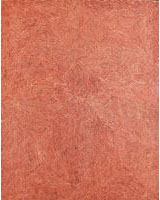 |
Pirrinya,
2004
Synthetic polymer paint on Belgian linen,
152 x 123 cm, Est:
$6,000-8,000, Cooee Art, Aboriginal Works of Art, Sydney, 03/12/2019,
Lot No. 40
|
$13,200 |
|
|
|
|
|
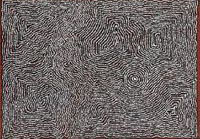 |
Tingari
Acrylic on canvas,
95 x 130 cm, Gaia Auction, Aboriginal Art, Paris,
14/05/2011, Lot No. 13
|
$12,652 |
| |
|
|
|
 |
Tjiparitjarra, 2002
Synthetic polymer paint on linen, inscribed verso: artist's name, size
and Papunya Tula Artists Pty Ltd catalogue number CT0209073,
183 x 151.5
cm, Est: $5,000-7,000, Deutscher and Hackett, Inaugural Aboriginal Art
Auction, Melbourne, 25/03/2009, Lot No. 92
|
$9,900 |
|
|
|
|
|
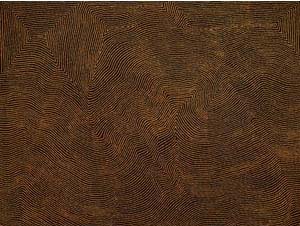 |
Pirrinya, north west of Jupiter Well, 2006
Synthetic polymer paint on Belgian linen,
138 x 182 cm, Est:
$8,000-12,000, Cooee Art, Indigenous Fine Art, Sydney, 08/03/2022, Lot
No. 88 |
$9,600 |
| |
|
|
|
|
|
|
Charlie
Tjapangati biography
.png)
Charlie Tjapangati is a renown
Australian
artist and
one of the leading
Papunya Tula
artists. He started painting for
Papunya Tula Artists
cooperative
in 1978.
Charlie Tjapangati was born
circa 1949 North
West of Jupiter Wells of the
Pintupi
Tribe
Tribe/Clan:
Pintupi
Country:
Kiwirrkura
Area: Central and Western Desert
Western Desert
Language
Western Desert also known
as
Papunya Tula
Charlie Tjapangati
exhibited
in USA
'Mr. Sandman bring me a Dream' (1981)
with
Billy Stockman,
the founder of Papunya Tula Artists.
Tjapangati work is
held
worldwide,
Collections
include
Art Gallery of South Australia,
Queensland Art Gallery,
Australian Art Gallery,
National Gallery of Australia,
Museum & Art Gallery Northern
Territory,
National Gallery of Victoria,
Art Gallery of Western Australia,
Homes
a Court Gallery Collection,
Tasmanian Museum and National Art
Gallery,
Kelton
Foundation, USA
etc.
Charlie Tjapangati
work is sought after by collectors worldwide.
His
paintings
have
the sheer physical presence of the much contemporary work of art. They are hypnotic, giving the impression of the multi-dimensional
illusion of space and depth.
His paintings
have
the sheer physical presence of the much contemporary work of art. The top-quality
works are hypnotic, giving the impression of the multi-dimensional
illusion of space and depth.
Pirrinya painting
sold for $13,200 at auction
in 2019.
AWARDS
In 1981
Charlie Tjapangati
traveled to
America
together with
Billy Stockman
one of the old Masters and the founder of Papunya Tula Artists
for 'Mr.
Sandman bring me a Dream' exhibition.
Dreamtime Wikipedia
Collections
Charlie Tjapangati work is
represented in Australia and around the world
World Vision Birrung Gallery
Australian Art Gallery
Art Gallery of South Australia
(Adelaide)
Queensland Art Gallery (Brisbane)
National Gallery of Australia
(Canberra)
Museum & Art Gallery Northern
Territory (Darwin)
Art
Bank (Sydney)
National Gallery of Victoria (Melbourne)
Gallery of Victoria (Melbourne)
Art Gallery of Western Australia (Perth)
Homes
a Court Gallery and gallery Collection (Perth)
Tasmanian Museum and National Art
Gallery (Hobart)
Kelton
Foundation
California, USA
Flinders University Art Museum
Aboriginal Art Museum, Utrecht The Netherlands
AAMU
Museum
for contemporary
Aboriginal Art,
The Netherlands
University of Virginia USA
World Vision
Australia - Birrung Gallery
Exhibitions
1980
Contemporary Australian Aborigine Paintings, Pacific Asia
Museum, Pasadena, California, USA
1981 Australian Perspecta, A Biennial Survey of Contemporary
Australian Art, Art Gallery of NSW Sydney
1982 Brisbane Festival, Brisbane
1982 Georges Exhibition,
Melbourne
1983 Mori Gallery, Sydney
1989 Masterpiece Fine Art Gallery,
Hobart
1990 Paintings from the Desert, Contemporary Aboriginal
Paintings
1990 Plimsoll Gallery, Centre for the Arts, Hobart,
Tasmania
1992 Crossroads-Towards a New Reality, Aboriginal Art from
Australia
1992
National Museums of Modern Art, Kyoto and Tokyo
2000
Art Gallery of
NSW, Papunya Tula Exhibition of 2000
2004 21st Telstra National Aborigainal
& Torres Strait
Islander Art Award, Museum Northern
Territory
2005 Papunya Tula Artists, Gallery Gabrielle Pizzi, Melbourne
2005 Papunya Tula Artists - new work for a new space, Utopia Art
Sydney
2005 Rising Stars Papunya, Gallery Gabrielle Pizzi,
Melbourne.
2006 Papunya Tula Artists - across the board, Utopia Arts Sydney,
Sydney
2006 Rising Stars 2006, Gallery Gabrielle Pizzi,
Melbourne
2007-8
National Museum of
Australia Exhibition: Papunya Painting 28
November 2007 - 3 February 2008
Dreamtime
The expression "Dreamtime" was coined in 1899 by
Spencer and
Gillen (who conducted formative
anthropological work on Australian
prehistory) from alcheringa
of the
Arrernte language.
"Dreamtime" is
often used as a collective term for all the Dreamings of the
indigenous peoples, though "The Dreaming" is a synonym for
"Dreamtime" and is culturally preferred by Indigenous Australian
people.
"The Dreaming" in modern scholarship often refers to the
"time before time", "time outside of time" or "time of the creation
of all things", as though it were the past. But The Dreaming in a
real sense is also present and in the future.
The
anthropologist and
historian
W.H. Stanner preferred "the
Dreaming" to "the Dreamtime" and saliently describes it as "the
Everywhen".
This is an apt and evocative approximation to what the Indigenous
Australian Peoples refer to in translation as the "All-at-once" Time
which is experienced as a co-existing confluence of
past,
present and
future.
This does not counter the
Indigenous Australians People's concept of
linear time, but it informs and
qualifies it.
Indigenous Australians considered the Everywhen of the
Dreaming to be
objective, whilst linear time was
considered a
subjective construction of
waking
consciousness of one's own lifetime.
This is in
the converse of the European concept which views dreams as
subjective and linear time as objective.
Literature
Source
& FURTHER
REFERENCES
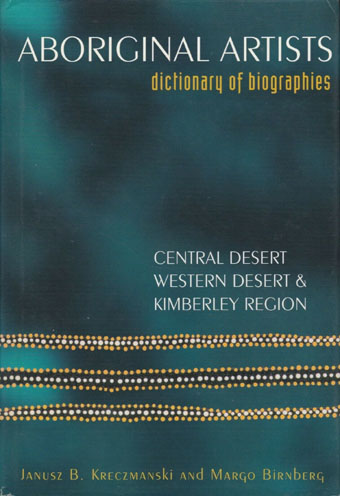
Australian Aboriginal Artist dictionary of biographies
Kreczmanski, Janusz B
and Birnberg, Margo (eds.): Aboriginal Artists: Dictionary of Biographies:
Central Desert, Western Desert and Kimberley Region JB Publishing Australia,
Marleston, 2004.
Aboriginal Artists of the Western Desert - A Biographical Dictionary by Vivien
Johnson, published by Craftsman House 1994
The
Oxford Companion to Aboriginal Art and Culture edited by Sylvia Kleinert and
Margo Neale published by OUP 2000
Aboriginal Artists: Dictionary of Biographies: Central Desert, Western Desert &
Kimberley Region JB Publishing Australia, Marleston, 2004
Brody, A. 1989 Utopia women’s Paintings: the First Works on Canvas, A summer
Project, 1988-89 exhib. Cat. Heytesbury Holdings, Perth Brody
A.
1990 Utopia, a picture Story, 88 Silk Batiks from the Robert Homes a Court
Gallery and gallery Collection, Heytesbury Holdings LTD Perth NATSIVAD database,
Latz, P. 1995, Bushfires & Bushtucker, IAD Press, Alice Springs
Brody, A. 1989 Utopia women’s Paintings: the First Works on Canvas, A summer
Project 1988-89 exhib. Cat. Heytesbury Holdings, Perth Brody
Australian
Aboriginal art
Geoffrey Bardon
Kluge-Ruhe Museum
Papunya
-
Toas
Papunya Tula
Gallery
Art Gallery of
NSW, Papunya Tula Exhibition of 2000
National Museum of
Australia Exhibition: Papunya Painting 28
November 2007 - 3 February 2008
Dreamings of the Desert: Aboriginal dot
paintings of the Western Desert,
Art Gallery of South
Australia, 1996,
ISBN 0-7308-3073-X
Geoffrey Bardon,
Aboriginal Art of the Western Desert,1979,
Adelaide: Rigby
Geoffrey Bardon,
Papunya Tula: Art of the Western Desert,
1991,
ISBN 0-86914-160-0
Sydney: McPhee Gribble/Penguin
Geoffrey Bardon
and James Bardon, Papunya: A Place Made After
the Story: The Beginnings of the Western Desert
Painting Movement, 2006, Miegunyah Press,
University of Melbourne
Roger Benjamin,
2005, The beginnings of the Western Desert
painting movement, The Age, January 29
Vivien Johnson
(ed), Papunya Painting: Out of the desert
2007, Canberra: National Museum of Australia.
Amadio, N. und Kimber,
R., Wildbird Dreaming. Aboriginal Art from the Central Deserts of Australia,
Greenhouse Publ., Melbourne 1988; Auckland City Art Gallery, Auckland 1990,
Ausst. Kat.; Australian Aboriginal Art from the Collection of Donald Kahn. Lowe
Art Museum, University of Miami (Hrsg.), 1991, Ausst. Kat.; Droombeelden -
Tjukurrpa. Groninger Museum (Hrsg.), Groningen 1995, Ausst. Kat.; Isaacs, J.,
Australia´s Living Heritage. Arts of the Dreaming, Lansdowne Press, Sydney 1984;
Isaacs, J., Australian Aboriginal Paintings. Lansdowne, Sydney 1989, ISBN
186302011X; Johnson, V., Aboriginal Artists of the Western Desert. A
Biographical Dictionary, Craftsman House, East Roseville 1994, ISBN 9768097817;
Modern Art - Ancient Icon. The Aboriginal Gallery of Dreamings (Hrsg.), o.O.
1992, ISBN 0646080520; Nangara. The Australian Aboriginal Art Exhibition from
the Ebes Collection. The Aboriginal Gallery of Dreamings (Hrsg.), Melbourne
1996, Ausst. Kat.; Stourton, P. Corbally, Songlines and Dreamings. Lund
Humphries Publ., London 1996, ISBN 0853316910; The Painted Dream. Contemporary
Aboriginal Paintings. Johnson, V. (Hrsg.), Auckland City Art Gallery, Auckland
1991, Ausst. Kat.; Tjinytjilpa. The Dotted Design. Aboriginal Art Galleries of
Australia (Hrsg.), Melbourne 1998, Ausst. Kat.; Traumzeit - Tjukurrpa. Kunst der
Aborigines der Western Desert. Die Donald Kahn-Sammlung, Danzker, J.B. (Hrsg.),
Prestel, München und New York 1994, Ausst. Kat.; Voices of the Earth. Paintings,
Photography and Sculpture from Aboriginal Australia. Gabrielle Pizzi (Hrsg.),
Gallery Gabrielle Pizzi, Melbourne 1996, Ausst. Kat., ISBN 0646288954.
RETURN TOP
|
|
|
|
Tingari
men
business
Painted in 2005,
CT0702
and
CT0702 works
depict an ancient story of
Mythological Times the travels of a large group of
Tingari
men.
Charlie Tjapangati
work generally depict the
significant ceremonial story of the
Tingari
Cycle.
The
Tingari
men
were a group of ancestral elders who in the
Dreaming
time travelled over vast areas of the
Western Desert,
performing rituals and creating or "opening up" the country (Perkins
& Fink 2000)
"Classical" Tingari cycle paintings contain a network of roundels
(concentric circles, which often signify sites) interlinked by lines
which indicate travel (Bardon
1991). The
Tingari
men
camped at the site of “Yatturlnga” before traveling east passing
through “Kiwirrkura” area.
The men travel on to “Tarkul” North of
Mount Webb and then North to
Lake Mackay.
The travel of
Tingari
men is depicted in the centre of
painting. The wavy lines depict the sand hill surrounding the soakage
water site of Yatturlnga, southwest of Jupiter Well. Since events
associated with Tingari Cycle are of a secret nature no further details
are given.
Tingari-related visual designs, such as
those used in ceremonial body and
ground paintings, are usually
considered "dear" rather than "dangerous" by traditional owners,
which may explain why so many artists have concentrated on the
Tingari in paintings produced for public display and sale by
Papunya Tula.
Even so, the more esoteric elements of these
designs were usually modified or omitted by the artists, and this is particularly true of recent
works.
The surface narrative elements that are often termed the
painting’s ‘story’ or ‘Dreaming’
are only one level of an Aboriginal painting’s true
significance.
The imagery employed by
Aboriginal artists has a deep cultural resonance that often
defies simple logic or narrative interpretation. The western
viewer can, however, intuitively feel the power of this
spiritual resonance without necessarily having to understand the
details, which are essentially for the initiated only.
The
Tingari
men
were usually accompanied by recently-initiated novices to whom they
provided instruction in the ritual and law of the region.
The adventures of the Tingari groups are enshrined in numerous song-myth
cycles which provide explanations for contemporary customs in
Western Desert
aboriginal life.
The
adventures of the Tingari groups are enshrined in numerous song-myth
cycles which provide explanations for contemporary customs in
Western Desert
aboriginal life. Deep
knowledge of Tingari business is restricted to men possessing
appropriate levels of seniority in
Western Desert
society, but many stories have "public versions" which do not
disclose secret/sacred knowledge.
In the Tingari heartland of
the
Gibson Desert,
three major journey-lines can be discerned (Myers
1986).
One begins west of Jupiter Well and eventually runs due east,
concluding south-east of
Lake Mackay
another heads south-west from near
Kintore
for some 200 km, and then doubles back to end at Lake Macdonald; the third runs from south to
north through
Docker River and
Kintore.
At the many sites that make
up these
song lines, groups of Tingari people
held ceremonies, experienced adversity and had adventures, in the
course of which they either created or became the physical features
of the sites involved. In mythological terms, Tingari exploits often
add to or modify features at pre-existing sites, or revive and
extend more ancient local
Dreamings.
The oral narratives that describe these
adventures stretch to thousands of verses, and provide countless
topographical details that would assist
nomadic bands to
navigate and
survive in the arid landscape.
In
Pintupi narratives, the male Tingari
groups are usually followed by groups of women who may be
accompanied by children. The more public women's stories usually
revolve around the gathering and preparation of bush foods. However, other narratives relate to
a group of powerful ancestor women – the Kanaputa (Ganabuda) or
Mungamunga who often
travelled in a Tingari ritual group.
These Tingari women were sometimes accompanied
by young girls, whom they provided with ritual education, and were often followed by (or following)
groups of Tingari men. Many of the Kukatja stories collected at
Balgo relate to the Kanaputa.
In the
Tingari
heartland of the
Gibson Desert,
three major journey-lines can be discerned.
One
begins west of Jupiter Well and eventually runs due east, concluding
south-east of
Lake Mackay
another heads south-west from near
Kintore
for some 200 km, and then doubles back to end at Lake Macdonald; the
third runs from south to north through
Docker River
and
Kintore.
At
the many sites that make up these
song lines,
groups of Tingari people held ceremonies, experienced adversity and had
adventures, in the course of which they either created or became the
physical features of the sites involved. In mythological terms, Tingari
exploits often add to or modify features at pre-existing sites, or
revive and extend more ancient local
Dreamings.
The oral narratives that describe
these adventures stretch to thousands of verses, and provide countless
topographical details that would assist
nomadic
bands to navigate and survive in the arid landscape (Petri
1970:263).
In
Pintupi
narratives, the male Tingari groups are usually followed by groups of
women who may be accompanied by children.
The
more public women's stories usually revolve around the gathering and
preparation of bush foods.
However, other narratives relate to a group of powerful ancestor women, the Kanaputa (Ganabuda) or Mungamunga who often travelled in a Tingari ritual group.
These Tingari women were sometimes accompanied by young girls, whom they
provided with ritual education,
and were often followed by (or following) groups of Tingari men.
Many
of the Kukatja stories collected at
Balgo
relate to the Kanaputa.
|
|
|
|
|
|
Papunya Tula
In 1972 the artists
established their own company, Papunya Tula, which derives its name
from both the settlement's name and one of the hills in the area,
Tula, a Honey Ant Dreaming site.
In the late 1970s and early '80s,
after the establishment of the
Aboriginal Land Rights Act, many
people moved back to their traditional homelands, to country as far
west as
Kintore and
Kiwirrkura
in
Western Australia.
In the 1980s the
movement flourished and other desert communities such as
Utopia,
Yuendumu and
Balgo began to produce works of art
for an outside audience.
In 2000, the
Art Gallery of NSW held an
exhibition,
curated by
Hetti Perkins,
for the
Sydney Olympic Games Arts Festival.
This exhibition was to firmly place the movement on the national,
and international, stage.
For a period of several months (27
November 2007 to 3 February 2008), the
National Museum of Australia exhibited a collection of Papunya
paintings from the first few years of the movement.
Most of the
works displayed in the collection have not been seen before by the
general public as most of these paintings were bought by (the now
defunct government agency) the Aboriginal Arts Board of the
1970s-1980s.
The exhibition contains some of the most priceless and
earliest works by the first generation, senior Papunya painters.
These paintings were previously displayed in government offices and
embassies. This exhibition was
curated by Professor Vivien Johnson and is significant in
introducing the movement's impact to the mainstream.
Charlie Tjapangati work is in tThe
Musée
Quai Branly,
the World's most important Museum
that is dedicated to indigenous art of the world.
Papunya artists, Tommy Watson
and
Ningura Napurrula are
also represented in
Paris, in the
Musée
Quai Branly .
Musée
Quai Branly
commissioned
Ningura Napurrula
paint her signature black
and white motif to superimposed on the ceiling of the
museum's building.
RETURN TOP |
|
|

Galeria Aniela provides an independent professional service
and experienced guidance
representing clients best interest in the art market.
We welcome the opportunity to speak with you, please feel free to
contact us
to discuss ways in which Galeria Aniela can assist you now and in the future.
Whether you are a first-time buyer, an astute investor or enthusiastic
collector, our people focused approach ensures an enjoyable and rewarding
experience.
video | Galeria Aniela Fine Art broker
Combining a wide network of resources with
expertise in Australian fine art, we
assist clients in all aspects of
acquisitions of fine art objects,
shipping worldwide,
ensuring impeccable
provenance
and quality,
helping save
time and
money.
Testimonials
Founded in 1994, Galeria Aniela exhibited world-class artists
and received celebrities including Sir David
Attenborough, Cameron
O’Reilly
and
Hon Bob Hawke,
Australian Prime Minister.
Galeria Aniela
built
a
strong
standing
in Australia and internationally.
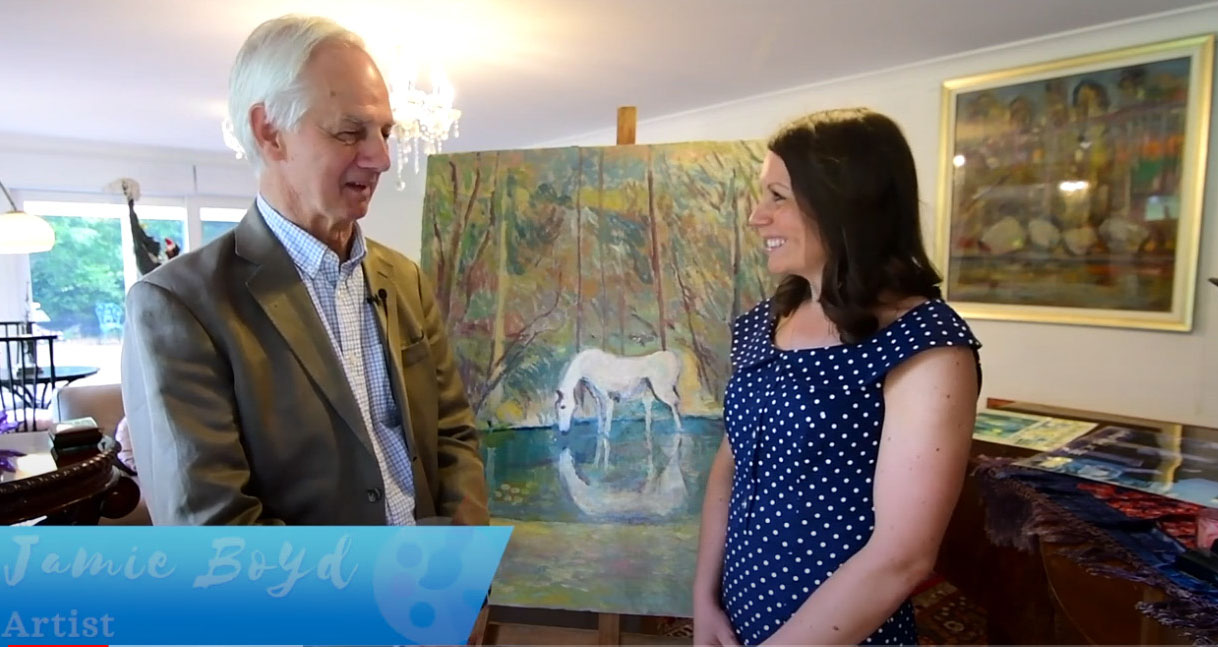
Video |Jamie Boyd, the Boyd family most
important LIVING artist
The
BOYD family
exhibition
in Galeria Aniela coup the
front page
Sydney Morning Herald,
Australian National NEWS ABC TV
&
Sunday Afternoon ABC TV.
John Perceval Retrospective won
the Australian
National NEWS ABC TV and
Charles Blackman Retrospective conquer
Australian
Art Scream |SBS
TV.
Works of art live for generations, constantly reborn in the minds of the
beholders to bring new meanings, new dreams, new ways of seeing and experiencing
the world. Be part of this magic world of amazing fine art from the ocean of
tranquillity to
concur
the heart, mind and soul.
The vision of Galeria Aniela is to increase the awareness of Australian
artists
cultural contribution. Through hard work and dedication, in a peaceful manner,
we strive for high ideals to create a better future for the arts.
When you purchase Art from
Galeria Aniela,
you make a valuable contribution to our mission of helping artists to make a
living with their creations and together we make a difference.
|
|
|
|
|
|