|
Robin
Holliday 1932-2014 |
If you love
Art of
impeccable
provenance,
the
art
you want is at
Galeria Aniela
|
|
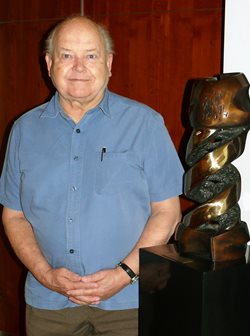
An eminent sculptor, Robin Holliday (1932-2014)
PhD, FRS, FAA
was also one of the World’s greatest
molecular biologist.
Holliday art
exemplify
Modernism
in
sculpture.
Influenced by British school of
abstract,
Henry Moore,
Barbara Hepworth,
Lynn Chadwick
and
Reg
Butler, Holliday created bronzes
using the
Lost-wax casting (called
investment
casting)
produce
museum-quality works of art.
Robin Holliday kinetic mobile bronzes principle is based on the fact that the centre of gravity of
the top piece that is below the
point of rotation, so that the sculpture is balanced. A gentle push to
the top piece sets it in motion and momentum takes over. Holliday's kinetic mobile sculptures pay homage to Isaac Newton in exploiting gravity and angular
momentum.
Holliday work is in many
collections around the
world including
The Royal Society London,
Institute Laboratory of Molecular Biology Cambridge,
Children Medical Research Institute Sydney,
University of Sussex UK,
Rockefeller University
New York,
Macquarie University Sydney. |
|
|
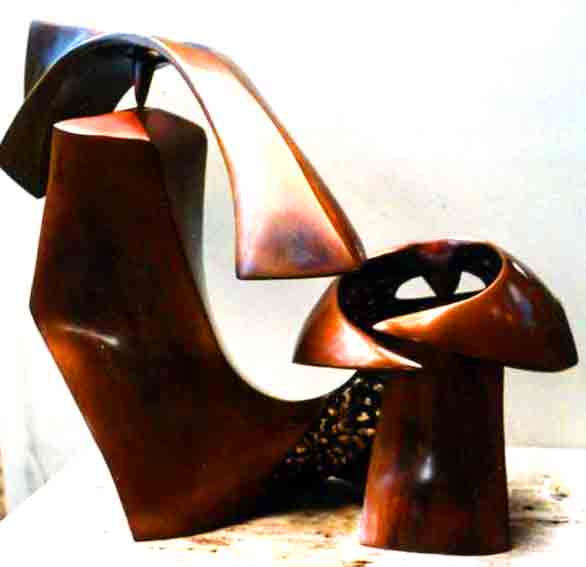
Robin Holliday
(1932-2014)
DUAL
Mobile
(rotates)
Bronze
Size: 75 cm x 75 cm x 55 cm
Price:
ENQUIRE
|
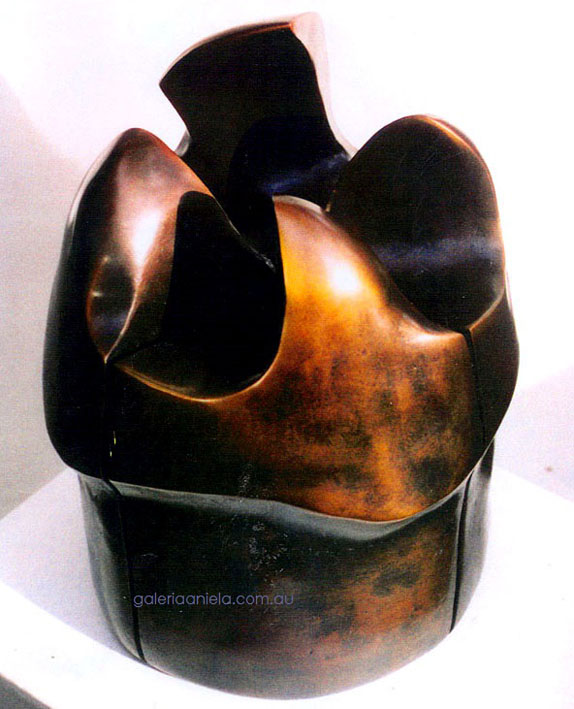
Robin Holliday
(1932-2014)
Tetrad
Bronze
Size: 38 cm x 25 cm x 15 cm
Price:
ENQUIRE |
|
|
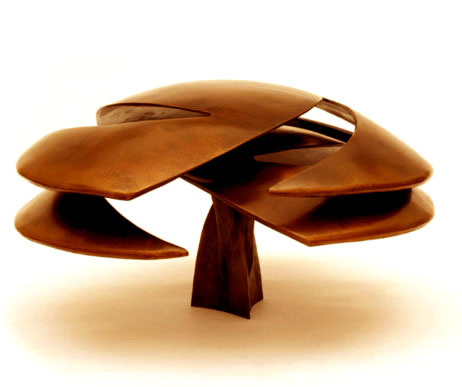
Robin Holliday
(1932-2014)
Homage to Newton
(rotates)
Bronze
Size: 60 cm x 40 cm x 36 cm
Price:
ENQUIRE
|
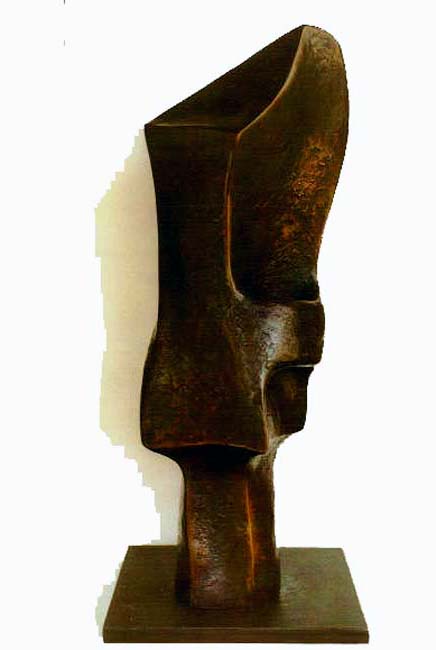
Robin Holliday
(1932-2014)
Obelisk
Bronze
Size: 90 cm
Price:
ENQUIRE
|
|
|
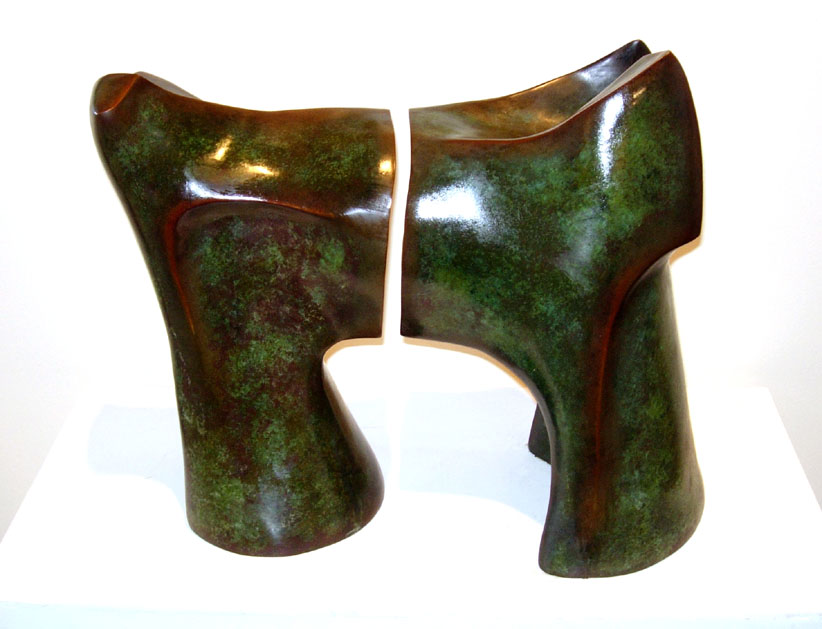
Robin Holliday
(1932-2014)
Synapse
Bronze
Size: 40 cm x 36 cm
Price:
ENQUIRE
|
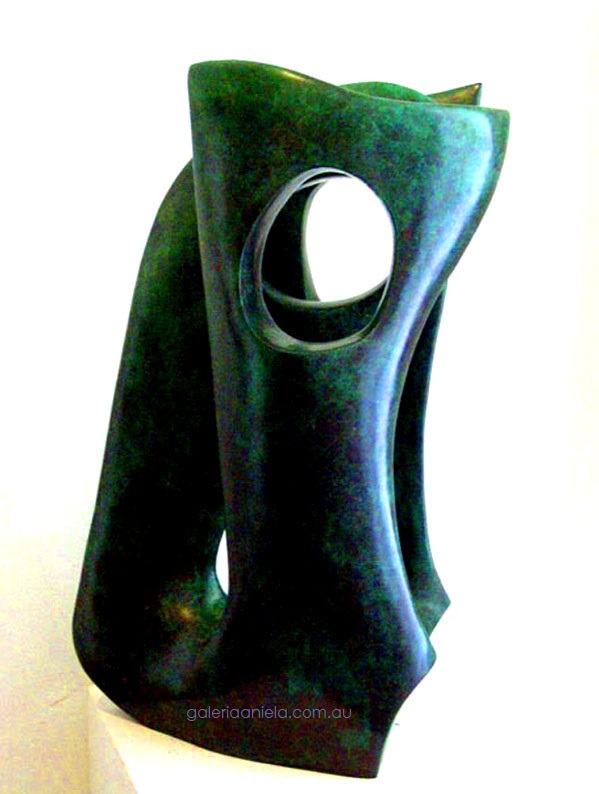
Robin Holliday
(1932-2014)
Lacunae
Bronze
Height: 60 cm
Price:
ENQUIRE
|
|
Prices
subject to change without a prior notice |
|
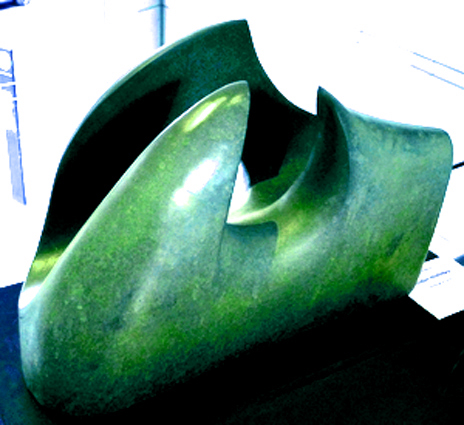
Robin Holliday
(1932-2014)
Hollow Form
Bronze
Size: 50 cm x 35 cm
Price:
ENQUIRE
|
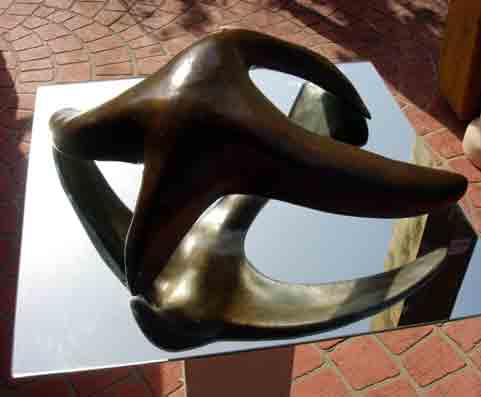
Robin Holliday
(1932-2014)
Bird
Bronze
Size: 75 cm x 62 cm x 27 cm
Price:
ENQUIRE |
|
|
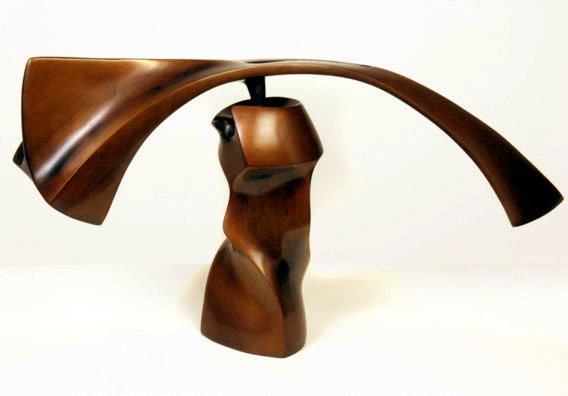
Robin Holliday
(1932-2014)
Mobile Single (rotates)
Bronze
Size: 68 cm x
68 cm x 37 cm
Price:
SOLD |
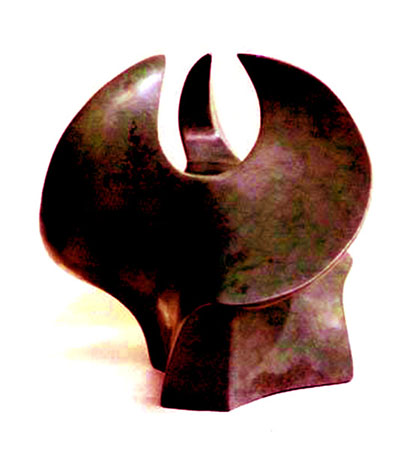
Robin Holliday
(1932-2014)
Triad
Bronze
Size: 22 cm x 22 cm
Price:
SOLD |
|
|
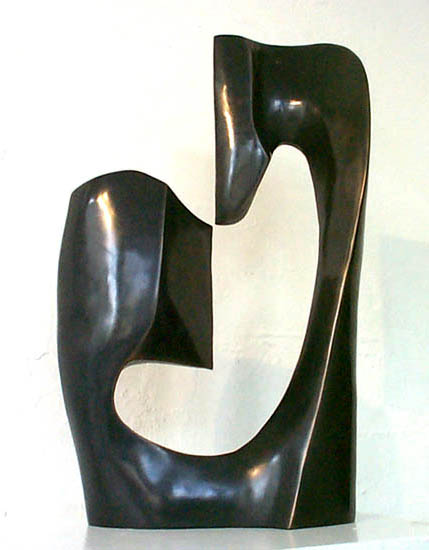
Robin Holliday
(1932-2014)
Dual Knife Edge
Bronze 6/6
Size: 54 x 34 cm
Price:
SOLD |

Robin Holliday
(1932-2014)
Dyad
Bronze 3/6
Size: 72 cm
Price
SOLD |
|
|
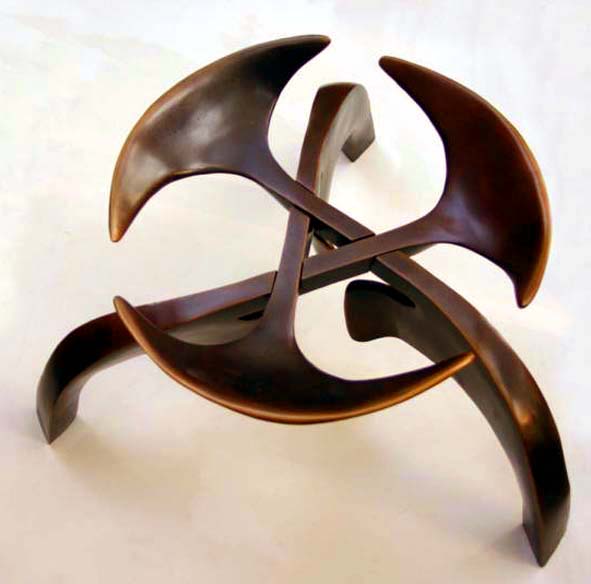
Robin Holliday
(1932-2014)
Triple Interchange
Bronze
Size: 70 x 70 x 33 cm
Price: SOLD |
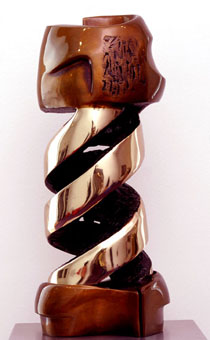
Robin Holliday
(1932-2014)
DNA Double Helix
Bronze
Size: 50 x 20 cm
Price: SOLD |
|
|
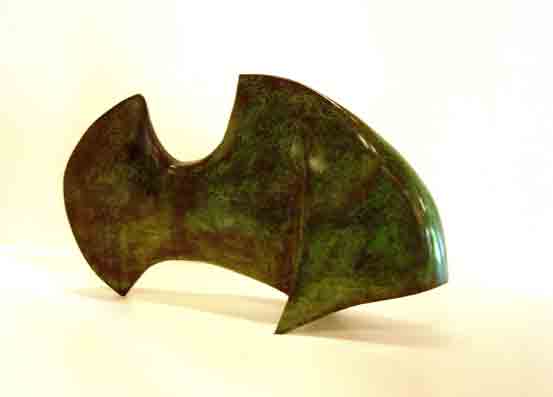
Robin Holliday
(1932-2014)
Fish
Bronze 6/6
Size: 40 cm x 60 cm
Price: SOLD |
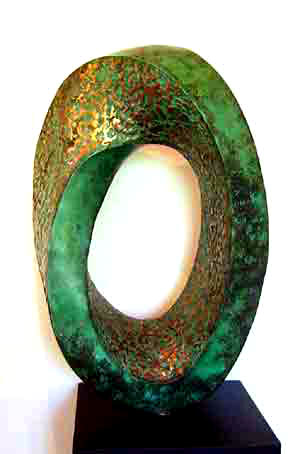
Robin Holliday
(1932-2014)
Endless Mobius Strip
Bronze
Size: 150 x 40 x 20 cm
Price:
SOLD |
|
|
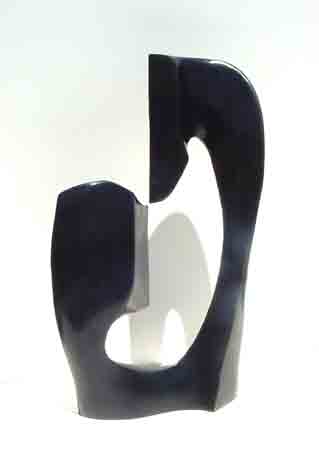
Robin Holliday
(1932-2014)
Dual Knife
Bronze 5/6
Size: 54 cm x 34 cm
Price:
SOLD |
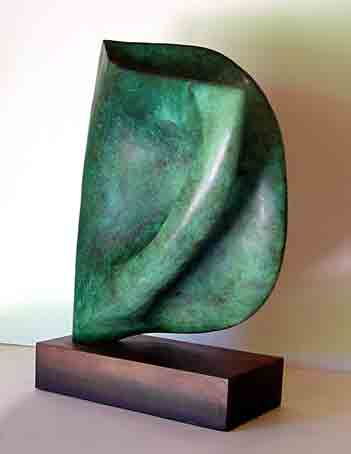
Robin Holliday
(1932-2014)
DIMORPHISM
Bronze on Wood
Height: 50 cm
Price:
SOLD |
|
|
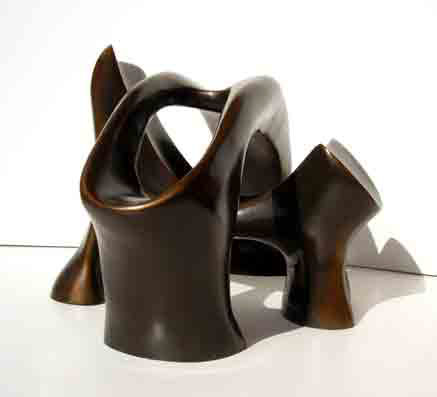
Robin Holliday
(1932-2014)
Crossing Over
Bronze
Size: 46 cm x 35 cm x 27 cm
Price:
SOLD |
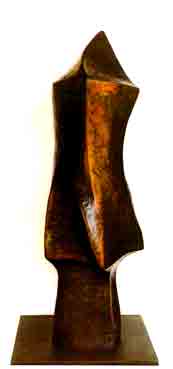
Robin Holliday
(1932-2014)
Obelisk
Bronze
Size: 90 cm
Price:
SOLD |
|
|
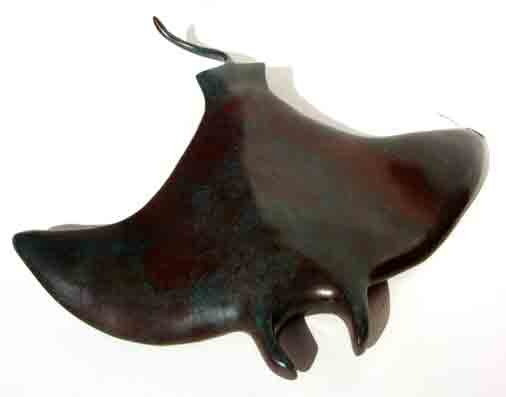
Robin Holliday
(1932-2014)
Manta Ray
Bronze
Size: 60 cm x 50 cm x 20 cm
Price:
SOLD |
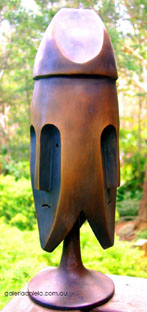
Robin Holliday
(1932-2014)
Mobile
Mask 1/1(rotates)
Bronze
Height: 50 cm
Price:
SOLD |
|
|
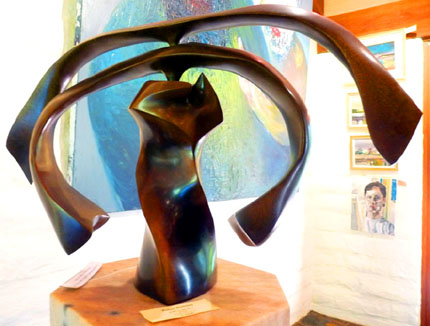
Robin Holliday
(1932-2014)
Mobile Double
Bronze
Size: 60 cm x 40 cm
Price:
SOLD |
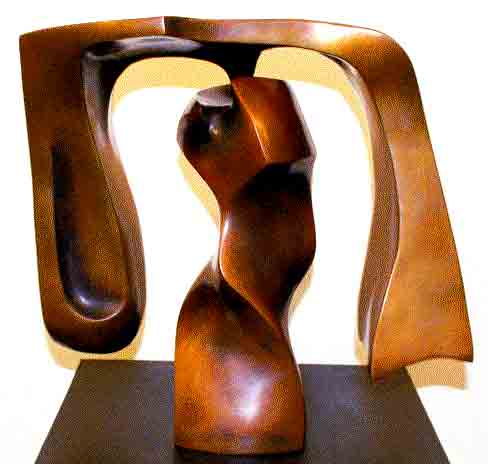
Robin Holliday
(1932-2014)
SINGLE mobile No.2
Bronze 5/12
Size: 60 cm
Price:
SOLD |
|
|
|
Robin
Holliday Biography
(1932-2014)
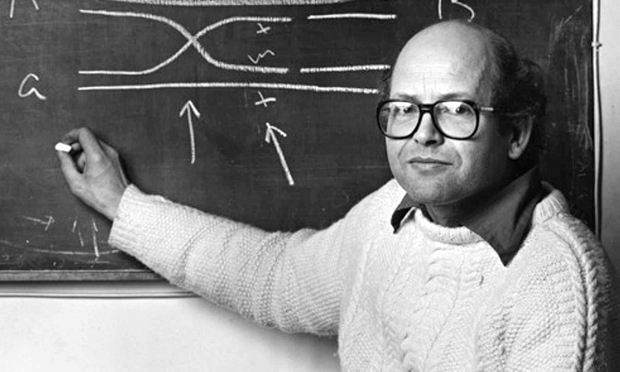 Robin Holliday
bronzes
exemplify
Modernism Robin Holliday
bronzes
exemplify
Modernism
An eminent sculptor, Robin Holliday (1932-2014)
PhD, FRS, FAA
was one of the World’s greatest
molecular biologist.
Holliday art
exemplify
Modernism
in
modern sculpture.
I nfluenced by the British school of
abstract
particularly
Henry Moore,
Barbara Hepworth,
Lynn Chadwick and
Reg
Butler, Holliday created bronzes
using the
Lost-wax casting (also called "investment
casting" or "precision casting") method that produce
museum quality fine art castings.
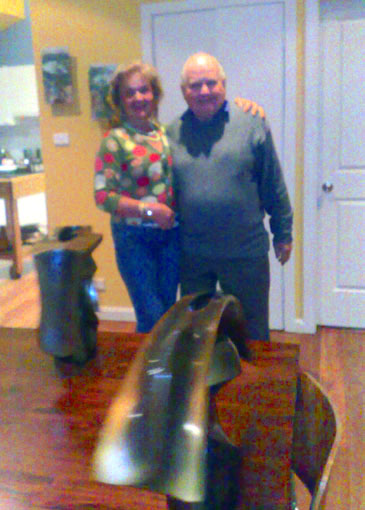 Photo: Aniela
and
Robin Holliday with his
kinetic and mobile bronze
Photo: Aniela
and
Robin Holliday with his
kinetic and mobile bronze
Robin Holliday kinetic and mobile bronze sculptures consist
of a sculpture base on which one or two pieces rotate. The
principle is based on the fact that the centre of gravity of
the top piece that is below the
point of rotation, so that it (they) is balanced. A gentle push to the
top piece (s) sets it in motion and momentum takes over. Some will
rotate for several minutes. Robin Holliday kinetic or mobile bronze
sculptures pay homage to Isaac Newton in exploiting gravity and angular
momentum.
Robin Holliday PhD, FRS, FAA
(1932-2014)
obtained a
Ph.D. in Genetics from
Cambridge University
in 1953.
One of the world’s greatest molecular
biologists Holliday made significant contributions to genetic
research.
Holliday was elected Fellow of the Royal
Society in 1976, a Foreign fellow of the Indian National Science Academy
in 1995 and a Fellow of the Australian Academy of Science in 2005 and he
was a member of the European Molecular Biology Organization. He was
awarded the Lord Cohen Medal for Gerontogical research in 1987 and
received the Royal Medal for his research on recombination and
epigenetics in 2012.
In 1964, Holliday proposed a
mechanism of DNA strand exchange that became known as the
Holliday Junction.
For more information on the
artist
scientific work please visit:
Robin
Holliday
- Wikipedia.
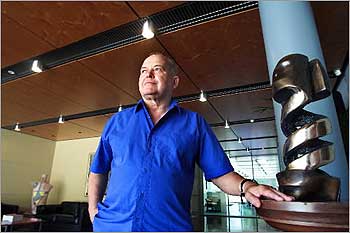 As an
artist,
Robin
Holliday
was
influenced by the British school of
abstract. As an
artist,
Robin
Holliday
was
influenced by the British school of
abstract.
Robin
Holliday
interest in sculpture dates back to the l960s
and l970s when the artist attended classes at an Art School in Hertford, Herts,
UK, and also at the
Camden Arts Centre, Finchley
in London.
Two of
Robin Holliday's instructors were the established sculptors
Jesse Watkins and Mark Harvey and three others had worked as assistants to
Henry Moore,
Barbara Hepworth
and
Eduardo Paolozzi.
Robin Holliday
mentors also include:
Lynn Chadwick,
Jesse Watkins
and
Reg
Butler.
From l998 Holliday has worked in Sydney in bronze and
mixed media. Robin
Holliday
modern sculpture
is
of great importance in
modern art,
the artist
contemporary
bronze sculpture
exemplify
Modernism.
Robin Holiday
Life's twisty journey, Professor Holliday at the Children's Medical Research
Institute. Photo: Robert Pearce |
|
DNA
Robin
Holliday
(1932-2014) with his
DNA
Double Helix
Bronze
The Double Helix is a
description of the molecular shape of a double-stranded DNA molecule. In 1953,
Francis Crick and James Watson first described the molecular structure of DNA,
which they called a "double helix," in the journal Nature. For this breakthrough
discovery, Watson, Crick, and their colleague Maurice Wilkins won a Nobel Prize
in Physiology, or Medicine, in 1962. However, a crucial contribution that
enabled this discovery was made by Rosalind Franklin, who was not acknowledged
at that time. After her death, Crick said that her contribution had been
critical.
Robin Holiday
Life's twisty journey, Professor Holliday at the Children's Medical
Research Institute. Photo: Robert Pearce
 

 RETURN TOP
 |
|
|
|
Robin
Holliday
bronzes can be described as
organic and
abstract especially
Diad.
The title of the abstract bronze
sculpture
Diad has a double meaning. It refers to the two parallel
pointed forms, and also to the fact that the sculpture contains two
contrasting components: the pointed forms and the rounded one encircling
the hole.
Other
Holliday's bronzes are stylized representations
of animals, such as Fish,
Bird
and Manta-Ray
and other have scientific symbolism
Homage to Newton,
Triad,
Triple Interchange and
DNA Double Helix.
The artist was able to
bridge the gap between representational forms and abstract
especially visible in: Lacunae,
Dual Knife
Edge,
Crossing Over
and
Synapse.
Robin Holliday
Möbius
Strip bronze sculpture is a mathematician confided a Möbius band is one-sided.
The artist said: 'you'll get quite a laugh, if you cut one in half, for it stays in
one piece when divided'. |
|
|
|
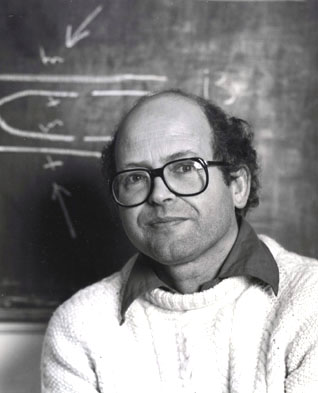 Robin
Holliday was also creating
kinetic sculpture
constructed to take advantage of the principle of
equilibrium.
Holliday
mobile sculptures pay homage to Isaac Newton in
exploiting gravity and angular momentum especially in
Homage to Newton,
Double Mobile no. 4,
Single Mobile no. 1 and
Single Mobile no. 2 Robin
Holliday was also creating
kinetic sculpture
constructed to take advantage of the principle of
equilibrium.
Holliday
mobile sculptures pay homage to Isaac Newton in
exploiting gravity and angular momentum especially in
Homage to Newton,
Double Mobile no. 4,
Single Mobile no. 1 and
Single Mobile no. 2
The mobile
principle is based on the fact that the centre of gravity of
the top piece is below the point of rotation, so the
sculpture is balanced.
These
consist of a sculpture base on which one or two pieces rotate. The
principle is based on the fact that the centre of gravity of the top
piece's is below the point of rotation, so the sculpture is balanced. A gentle push to the top
piece's sets it in motion and momentum takes
over. Some will rotate for several minutes.
The meaning of the term
"mobile" as applied to sculpture has evolved since it was
first suggested by
Marcel Duchamp
in 1931 to describe the early, mechanized creations of
Alexander Calder.
At this point, "mobile" was synonymous with the term
"kinetic art", describing sculptural works in which motion
is a defining property. While motor or crank-driven moving
sculptures may have initially prompted it, the word "mobile"
later came to refer more specifically to Calder’s
free-moving creations.
Influenced by the abstract work of
Piet Mondrian,
Joan Miró
and
Sophie Taeuber-Arp,
Calder in many respects invented an art form where objects
(typically brightly coloured, abstract shapes fashioned from
sheet metal) are connected by wire much like a balance
scale. By the sequential attachment of additional objects,
the final creation consists of many balanced parts joined by
lengths of wire whose individual elements are capable of
moving independently or as a whole when prompted by air
movement or direct contact. Thus, "mobile" has become a more
well-defined term referring to the many such hanging
constructs Calder produced in a prolific manner between the
1930s until his death in 1976. A succinct definition of the
term "mobile" in a visual art sense could be a type of
kinetic sculpture in which an ensemble of balanced parts
capable of motion are hung freely in space but which never
come into contact with each other. |
|
|
|
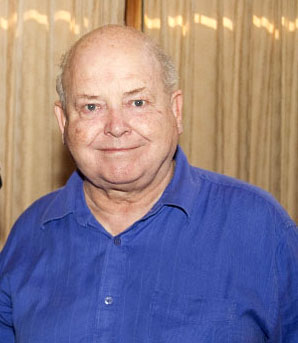
COLLECTIONS:
The Royal Society London
Institute Laboratory of Molecular
Biology Cambridge
Children Medical Research Institute Sydney
University of Sussex UK
Rockefeller University
New York
Macquarie
University Sydney
and many others
AWARDS
1976 Elected a Fellow of
the
Royal Society
1995 Foreign Fellow
of the Indian National Science Academy
2005 Member of the European Molecular Biology Organization
2005 Elected to the
Australian Academy of Science for fundamental contributions
to molecular genetics, epigenetics & cell biology
2005 Member of the European Molecular Biology Organization
2011 Awarded the Royal Medal, the Royal Society’s premier
award in excellence in science
BOOKS
Bibliography
Holliday was an authored and
he edited numerous books including:
1981 The Science of Human
Progress, Oxford University Press
1986 Genes, Proteins and
Cellular Aging, Van Nostrand Reinhold, New York
1995 Understanding Aging, Cambridge University Press
2000 Slaves and Saviours,
Blackwall Books
2007 Why We Age, Springer Science + Business Media
RETURN TOP |
|
|
|
ARTIST
STATEMENT
My interest in sculpture dates back to the
l960s and l970s when I attended classes at an Art School in Hertford,
Herts, UK, and also at the
Camden Arts Centre, Finchley
in London.
Two of
my instructors were the established sculptors
Jesse Watkins and Mark Harvey and three others had worked as assistants to
Henry Moore,
Barbara Hepworth
and
Eduardo Paolozzi.
I have worked with stone, wood,
clay and plaster. I also obtained instruction in art metalwork, and I
have experimented with mixed media.
My work is mainly abstract, but I
sometimes bridge the gap between representational forms and abstract
ones. This is in part due to the influence of organic shapes on my
sculpture. Working mainly in plaster, I can built up on wire
armatures.
By a combination of adding plaster and carving or wearing it
down I achieve the final form. This is then finished with a bronze
patina, or caste in bronze.
One of my abstract pieces, known
as "Diad", has been caste in bronze at Alan Crawford's foundry
in
Sydney
.
The title of the abstract bronze
sculpture "Diad" has a double meaning. It refers to the two parallel
pointed forms, and also to the fact that the sculpture contains two
contrasting components: the pointed forms and the rounded one encircling
the hole.
I have been influenced strongly by the established
British school of abstract sculpture, particularly
Henry Moore
and
Barbara Hepworth, but also
Lynn Chadwick,
Jesse Watkins
and
Reg
Butler.
My interest in organic forms can be related to the paintings, drawings
and prints of
Graham Sutherland.
As well as a sculptor, I am also an author,
and I earned my living until retirement in l997 as a
scientist, specialising in
genetics and
cell biology. I now have much more time
available to involve myself in sculpture. I have joined the Sculpture
Society and plan to exhibit pieces for sale at the various exhibition organised by the Society or by others.
RETURN TOP
|
|
|
|
making bronze sculptures
Making
bronzes is highly-skilled and costly work as the process
involves an expert fine art foundry using high-priced
ingredients and a number of distinct casting procedures
including
the lost-wax casting
(called
investment casting)
and also a team of extremely competent and experienced
professionals are employed.
To start with,
the artist made sculpture in plaster,
he used
non-drying oil-based clay
such as
Plasticine,
built up wire armatures and a combination of adding and
carving, he would create
a
full-sized model of the sculpture.
A wax (hollow for larger sculptures) is taken
and a mould-model
form created and cast in bronze at Alan Crawford's foundry
in Sydney.
Taking a Wax
form from the mould form
was the first step of the
Lost-wax casting
process in
Bronze.
Then
the full-size model of sculpture was cast at a
fine art
bronze
foundry,
using the
ancient form of
Lost-wax casting
(also called
investment
casting, or precision casting).
The
Lost-wax casting
method produce
museum-quality fine art
bronze
castings. Depending
on the artist decision making,
the outcome finish was different.
By applying
various chemicals the method produced sculptures with very different patinas
(surface finishes).
After a bronze was made final
polishing with corrosive materials was applied, to form a
patina,
a process that allows the artist to control the colour and
finish.
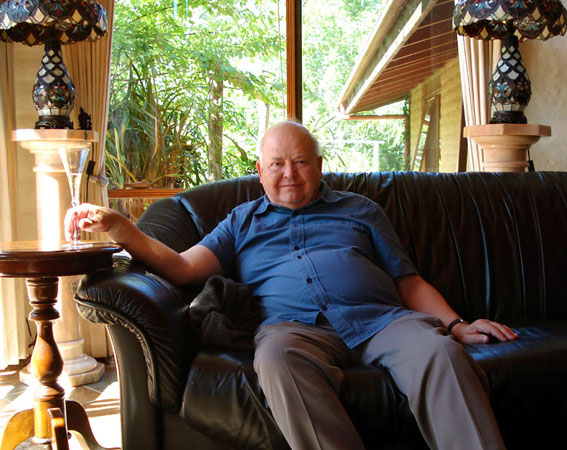 PHOTO: Robin
Holliday in Galeria Aniela
PHOTO: Robin
Holliday in Galeria Aniela
|
|
|
|
Casting
Sculpture
in Bronze
To
make fine art bronze
sculpture, the artist is
using the ancient form of
Lost-wax
casting
(also called
investment
casting or precision casting) method
to produce it's museum quality fine art bronze castings.
The "Lost Wax Casting Method" is an
incredibly accurate process for reproducing sculpture in
metals such as bronze. The method developed thousands of
years ago, and although modern techniques have improved the
process, still remains very expensive and labour intensive as
skilled craftspeople are needed every step of the way.
The process begins by taking the initial-original sculpture,
which might be made of materials such as clay, plaster,
wood, and making a "negative" wax then rubber impression of
it.
This negative rubber mould is used to produce a
replica of the original sculpture, with the properties and
thickness of the wax capturing all of the detail of the
design. The wax pattern is removed from the negative mould
and a skilled artisan retouches the seams and any
imperfections. Often the artist will review and approve or
decide to touch up the wax pattern further themselves.
Once the wax pattern is approved, a "circulatory system"
of wax tubes, often referred to as sprues, vents, and/or
gates is attached to the wax pattern. This system will allow
all the wax (in the soon to be made casting mould) to melt
out of the casting mould, and for the metal to be poured in,
and gas to escape. once gated, the wax pattern will be
encased or what's called "invested" in either a
traditional or solid investment molud or ceramic shell
casting mould.
Both of these methods use refractory materials to encase the
wax pattern and can withstand the temperature of the
de-waxing process and the molten metal. The casting mould is
placed in an oven or furnace and the wax is melted
away leaving the negative impression in the casting mould.
For the next step, bronze is melted to approximately 2000
degrees Fahrenheit (various alloys have slightly different
melting points and ideal pouring temperatures), and when
ready, the bronze is poured into the casting mould.
This is a particularly exciting and dramatic moment at the
foundry. After the metal cools, the metal finishers will
clean and chase the metal surface using a number of
tools, from hand held chasing tools, to air powered
grinders, and welding. Work is done until the cast meets the
qualities of the original model.
At this point, if it is bronze cast, the artist will often
want to further the color or patina from the natural metal
color achieved during the metal finishing.
The patina process is the application of chemicals to
the surface of the bronze that changes the chemical
composition of the metal so that it takes on a different or
varied color.
This
process is truly limited only by ones imagination and time.
Many great patinas have been achieved simply by allowing the
bronze to sit in nature and change with the air and moisture
around it.
In most cases at the foundry, we are required to make this
process happen quickly and this is done by heating the metal
and applying chemicals such as copper nitrate or ferric
nitrate. It can also be done without heat: a cold patina.
Either way, the patina process brings with it the many
wonderful qualities that make bronze so luminous. Aluminium
or other metal casts may be treated to achieve various
results, highlighting the metal. Most casts are waxed
for protection from the elements before they leave the
foundry.
|
|
|
|

Galeria Aniela provides an independent professional service
and experienced
guidance
representing clients best interest in the art market.
We welcome the opportunity to speak with you, please feel free to
contact us
to discuss ways in which Galeria Aniela can assist you now and in
the future.
Whether you are a first-time buyer, an astute investor or
enthusiastic collector, our people focused approach ensures an
enjoyable and rewarding experience.
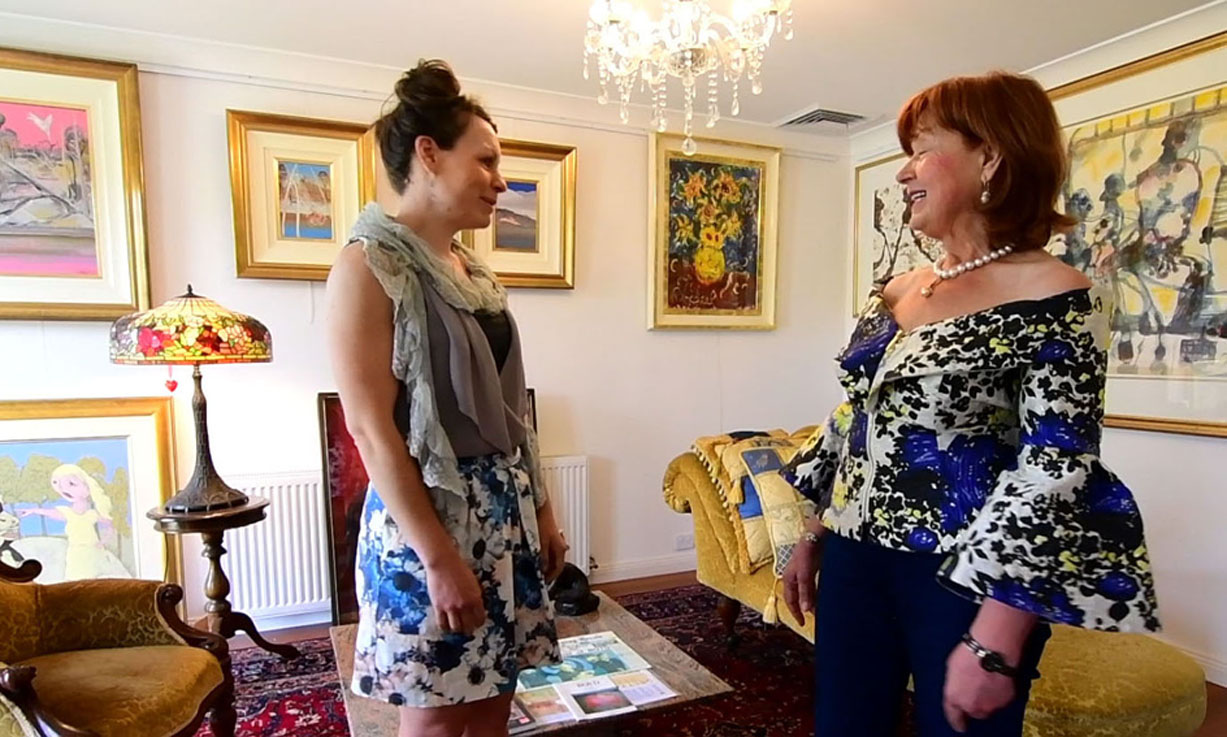
video | Galeria Aniela Fine Art broker
Combining a wide network of resources with
expertise in Australian fine art, we
assist clients in all aspects of acquisitions of fine art objects,
shipping worldwide,
ensuring impeccable
provenance
and
quality,
helping save
time and
money.
Testimonials
Founded in 1994, Galeria Aniela exhibited world-class artists
and received celebrities including
Sir David
Attenborough, Cameron
O’Reilly
and
Hon Bob Hawke,
Australian Prime Minister.
Galeria Aniela
built
a
strong
standing
in Australia and internationally.
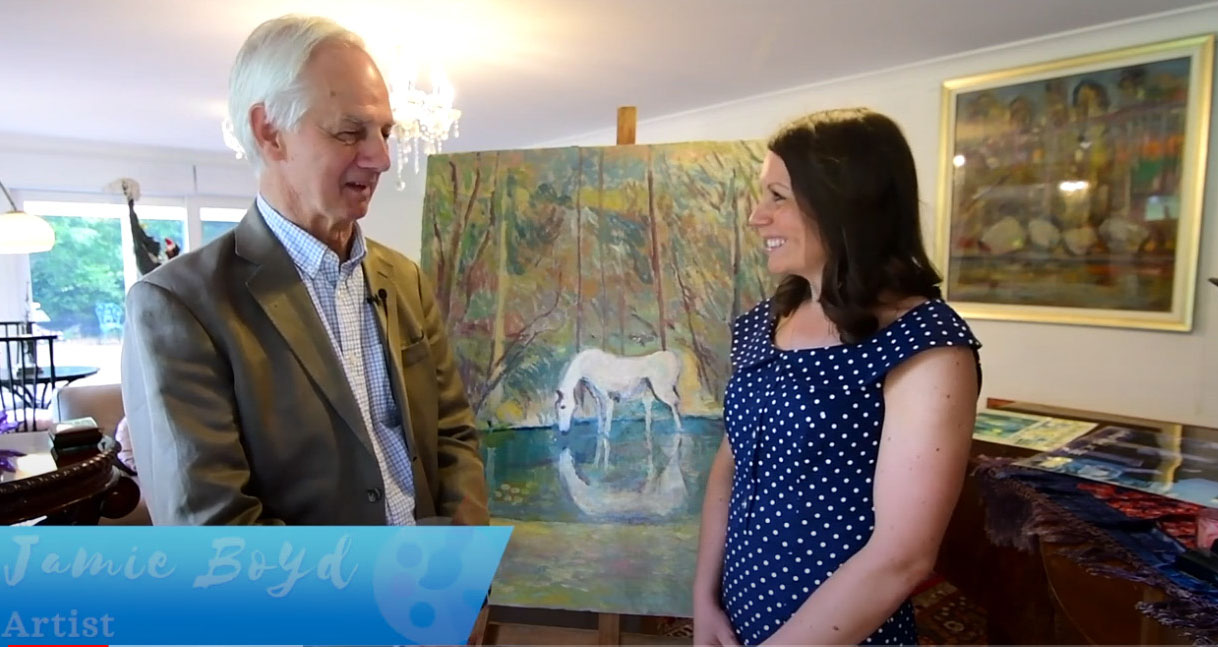
Video |Jamie Boyd, the Boyd family most
important LIVING artist
The
BOYD family
exhibition
in Galeria Aniela
coup the
front page
Sydney Morning Herald,
Australian National NEWS| ABC TV
and
Sunday Afternoon |ABC TV.
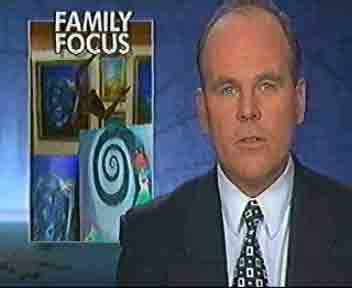
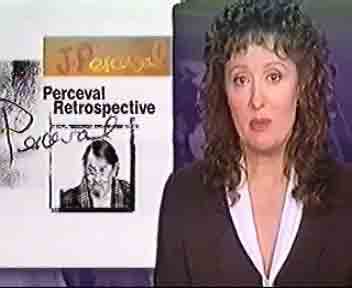
John Perceval Retrospective won
the Australian National NEWS |ABC TV and
Charles Blackman Retrospective conquer
Australian
Art Scream |SBS TV.
Works of art live for generations, constantly reborn in the minds of
the beholders to bring new meanings, new dreams, new ways of seeing
and experiencing the world. Be part of this magic world of amazing
fine art from the ocean of tranquillity to
concur
the heart, mind and soul.
When you purchase Art from
Galeria Aniela,
you make a valuable contribution to our mission of helping artists
to make a living with their creations and together we make a
difference.
|
|
|
|
|
 HOME
HOME