|

Don Tjungurrayi
B.1938
An ancient Aboriginal culture gave the World its most exciting
Contemporary Art
|
If you LOVE quality
Art of
impeccable
provenance,
the
art
you want is at
Galeria Aniela
|
|
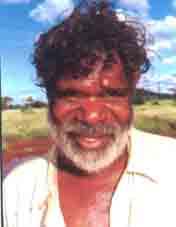
Born circa 1938, Don Tjungurrayi
is a well-known Australian artist.
Don has been painting since the beginning of the Aboriginal
Art movement, commencing in Papunya during the 1970s.
Tjungurrayi
won
number of Art prizes including
the prestigious
Alice Springs Art Prize in
1986.
Tjungurrayi
produced many exceptional paintings, his
Two Women Dreaming at Karrinyarra,
Acrylic on Belgian linen, 60 x 91 cm sold in Paris for $7,125 (€4,367) ArtCurial,
Art Aborigine Australien Collection Peter Los, Paris, 07/07/2008, Lot No. 44 (Est:
Eu2,400-2,600) Commentaire: Un certificat de Papunya Tula Artists PTY LTD n
DT820907 sera remis à l'acquéreur.
Don
Tjungurrayi
work is held in
worldwide
Collections
including
Kelton Foundation USA,
National Gallery Australia,
National Gallery of Victoria,
Art Bank,
Museum of Victoria,
Art Gallery of South Australia,
Australian Art Gallery,
Queensland Art Gallery,
Museum Art Gallery of NT,
Wollongong City Art Gallery,
Art Gallery of Western Australia,
Arts Centre Melbourne,
Hank Ebes Collection,
Araluen Arts Centre,
Broken Hill Regional Art Gallery,
Kerry Stokes
|
|
|
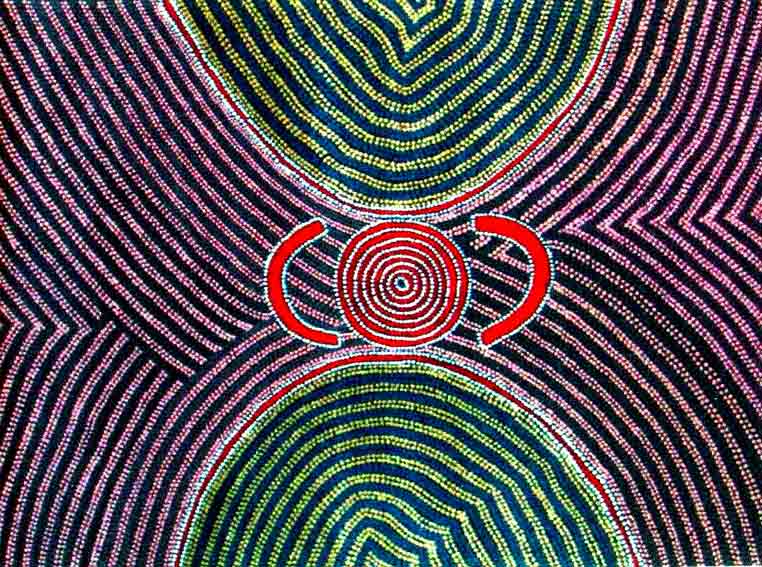 Don Tjungurrayi
(B.
1938)
Don Tjungurrayi
(B.
1938)
Initiation
Ceremony (2002)
Synthetic
polymer paint on Belgian linen
Image size: 122
cm x 92 cm
Frame size: 162 x 132 cm
Provenance:
Warumpi Aboriginal
Arts
Centre
PRICE:
Enquire
shipping
worldwide
Don Tjungurrayi
translates the
ancient
Ceremonies
into contemporary Art,
that
has
the
physical presence
of the much contemporary work of
fine art.
Initiation
Ceremony (2002)
is a contemporary abstract
work with a dramatic juxtaposition of colour and
arguably
Don Tjungurrayi
best
masterwork.
|
|
Warumpi Arts:
In 1994 Papunya Community Council established
Warumpi Arts
its own art centre-gallery
in Alice Springs, as the main centre for paintings by
Papunya artists, run by Aboriginal people of Papunya.
The
centre-art-gallery was maintained until September 2004. The
Papunya Community Council decided to close the gallery and
open
Papunya Tjupi Arts
art centre in
Papunya
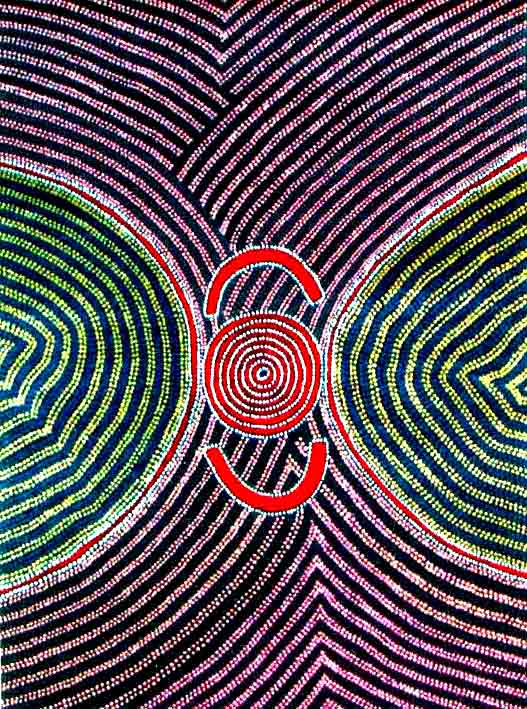 Don Tjungurrayi,
Initiation
Ceremony
Don Tjungurrayi,
Initiation
Ceremony
|
|
|
|
Don
Tjungurrayi
Biography
.png)
Don
Tjungurrayi
born
circa 1938, is a well-known Australian artist.
Don has been painting since the beginning of the Aboriginal
Art movement, commencing in Papunya during the 1970s.
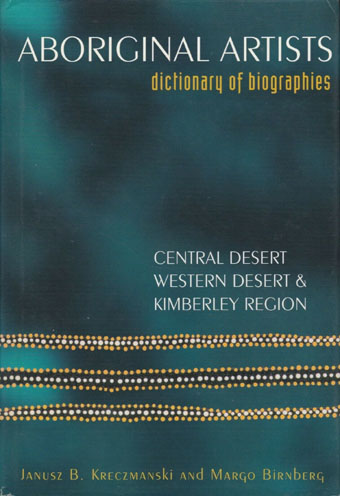
Biography
page 406
Australian Aboriginal Artists dictionary of
biographies
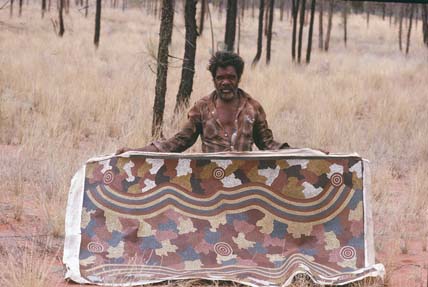
Photo
1989:
Don Tjungurrayi with his
painting -
Collection National Archives of Australia
Canberra
ABORIGINAL PEOPLE AND TORRES
STRAIT ISLANDER PEOPLES ART
Image no. A6135, K3/11/89/16A,
Barcode: 11689913,
Location: Canberra, Series accession
number: A6135/1
Warumpi Arts
Aboriginal Owned and Directed Art Galley,
the first Aboriginal
Community
Art Gallery
fully
operated by Aboriginal
artists.
In
early 1994 the Papunya Community Council established its own
art centre to give the Aboriginal people of Papunya an
increased involvement in the commercial aspects of
Aboriginal art. This centre, called
Warumpi Arts,
maintained a gallery in Alice Springs until September 2004
and was the main centre for paintings by
Papunya Tula Artists.
The Papunya Community Council then decided to close the
gallery with the aim of later opening an art centre in
Papunya.
AWARDS
1986 Don
Tjungurrayi won
the prestigious Alice Springs Art Prize with a very beautiful painting
of the
young
male’s initiation
ceremony.
While many ceremonies are public, Male Initiation Ceremonies
are secret and strangers, young women, non initiated boys
and girls would be limited in attending the sacred
ceremonies. The main categories of ceremonies are; education
of their sacred laws and behavioral codes and to ensure
continuation of totemic species to live in harmony with the
land. Aboriginal men perform the ceremonies at different
times of the year. Each ceremony has to be organized,
supervised and managed and the performance of each ceremony
dependents the person ownership, their knowledge as well as
their status. A concentric circle represents a meeting
place. Ceremonies involve songs, dances and body adornment.
Don Tjungurrayi was born at the Bungalow in Alice Springs Telegraph
Station in Australia, the year that World War two broke out.
Don
Tjungurrayi
attended the Yuendumu school and in his youth he worked as a drover and boundary
rider.
When the government establish the community of Yuendumu, Don
and his family moved there and this is where Don attended
school.
Don
was initiated near Haast’s Bluff and then began working as a
stockman and fencing contractor on various stations,
including Hamilton Downs. He married the widowed Entalura
Nangala and moved to Papunya where he was working in the
communal centre.
COLLECTIONS:
D on Tjungurrayi
work is represented in many significant colections such as
National Gallery Australia, Canberra
National Gallery of Victoria, Melbourne
Museum of Victoria, Melbourne
Art Gallery of South Australia, Adelaide
Australian Art Gallery, Canberra
Queensland Art Gallery Brisbane
Museum and Art Gallery of the Northern Territory, Darwin
Homes
a Court Collection, Perth
Wollongong City Art Gallery
NSW Australia
Art Gallery of Western Australia Perth
Arts
Centre Melbourne (original The Victorian Art Centre, Melbourne)
Art Bank Sydney
Hank Ebes Collection
Araluen Arts Centre
NT
Broken Hill Regional Art Gallery
Kelton Foundation
California
Kerry Stokes Collection
Arts Centre Melbourne
Exhibitions
1982 Aboriginal Artists Agency Ltd., Sydney, Australia
1982 Georges Exhibition, Melbourne, Australia
1983 Mori Gallery, Sydney, Australia
1983 Roar Studios, Melbourne, Australia
1984 Mori Gallery, Sydney, Australia
1984 Papunya and Beyond, Araluen Centre for the Arts, Alice Springs,
Australia
1984 Papunya Tula Artists Pty. Ltd., Alice Springs, Australia
1985 Aboriginal Artists Gallery, Melbourne, Australia
1986 Galerie Düsseldorf, Perth, Australia
1986 Queensland University, Brisbane, Australia
1987 4th National Aboriginal Art Award Exhibition, Museum & Art Gallery
of the Northern Territory, Darwin, Australia
1988 Chapman Gallery, Canberra, Australia
1991 The Painted Dream. Contemporary Aboriginal Paintings, Auckland City
Art Gallery, Auckland, New Zealand
1992 Araluen Centre for the Arts, Alice Springs, Australia
1992 Dreamtime Gallery, Broadbeach, Australia
1993 Art Gallery of Western Australia, Perth, Australia
1993 Chapman Gallery, Canberra, Australia
1993 Tjukurrpa. Desert Dreamings - A Survey of Central Desert Art
1971-1993, Art Gallery of Western Australia, Perth, Australia
1994 Araluen Centre for the Arts, Alice Springs, Australia
1994 Chapman Gallery, Canberra, Australia
1994 Dreamtime Gallery, Broadbeach, Australia
1995 Chapman Gallery, Canberra, Australia
1997 Geschichtenbilder, Aboriginal Art Galerie Bähr, Speyer, Germany
1998 Kunst der Kontinente.
Werke der Aborigines, Kunstverein Alsdorf, Germany (in
cooperation with the Aboriginal Art Gallery Bähr, Speyer)
1999 Zeichen des Seins. Malerei der australischen Aborigines, Städtische
Galerie ADA, Meiningen, Germany (in cooperation with the Aboriginal Art
Gallery Bähr, Speyer)
2000 BlickDicht - An- und Einblicke. Zeitgenössische Kunst australischer
Aborigines, Adelhausermuseum, Freiburg, Germany (in cooperation with the
Aboriginal Art Gallery Bähr, Speyer)
2000 Kunst der Aborigines, Leverkusen, Germany (in cooperation with the
Aboriginal Art Galley Bähr, Speyer)
2000 Traumpfade Zeitgenössische Malerei australischer Aborigines,
Städtische Galerie, Traunstein, Germany (in cooperation with the
Aboriginal Art Gallery Bähr, Speyer)
Tjungurrayi's paintings have also been exhibited in China,
Germany, Singapore, London and Brussels, and around
Australia
|
Literature
Source
& FURTHER
REFERENCES
Australian Aboriginal Artist dictionary of
biographies
Kreczmanski, Janusz B and Birnberg, Margo (eds.):
Aboriginal Artists: Dictionary of Biographies:
Central Desert, Western Desert and Kimberley Region
JB Publishing Australia, Marleston, 2004.
Aboriginal Artists of the Western Desert - A
Biographical Dictionary by Vivien Johnson, published
by Craftsman House 1994
The Oxford Companion to Aboriginal Art and Culture
edited by Sylvia Kleinert and Margo Neale published
by OUP 2000
Aboriginal Artists: Dictionary of Biographies:
Central Desert, Western Desert & Kimberley Region JB
Publishing Australia, Marleston, 2004
Brody, A. 1989 Utopia women’s Paintings: the First
Works on Canvas, A summer Project, 1988-89 exhib.
Cat. Heytesbury Holdings, Perth Brody
A. 1990 Utopia, a picture Story, 88 Silk Batiks from
the Robert Homes a Court Gallery and gallery
Collection, Heytesbury Holdings LTD Perth NATSIVAD
database, Latz, P. 1995, Bushfires & Bushtucker, IAD
Press, Alice Springs
Brody, A. 1989 Utopia women’s Paintings: the First
Works on Canvas, A summer Project 1988-89 exhib.
Cat. Heytesbury Holdings, Perth Brody
Australian Aboriginal art
Geoffrey Bardon
Kluge-Ruhe Museum
Papunya
-
Toas
Papunya Tula
Gallery
Art Gallery of NSW,
Papunya Tula Exhibition of 2000
National Museum of
Australia Exhibition: Papunya Painting 28 Nov
2007 - 3 February 2008
Dreamings of the
Desert: Aboriginal dot paintings of the Western
Desert,
Art
Gallery of South Australia,
1996,
ISBN
0-7308-3073-X
Geoffrey Bardon,
Aboriginal Art of the Western Desert,1979, Adelaide:
Rigby
Geoffrey Bardon,
Papunya Tula: Art of the Western Desert, 1991,
ISBN
0-86914-160-0
Sydney: McPhee Gribble/Penguin
Geoffrey Bardon
and James Bardon, Papunya: A Place Made After the
Story: The Beginnings of the Western Desert Painting
Movement, 2006, Miegunyah Press, University of
Melbourne
Roger Benjamin,
2005, The beginnings of the Western Desert painting
movement, The Age, January 29
Amadio, N. und Kimber, R., Wildbird Dreaming.
Aboriginal Art from the Central Deserts of
Australia, Greenhouse Publ., Melbourne 1988;
Auckland City Art Gallery, Auckland 1990, Ausst.
Kat.; Australian Aboriginal Art from the Collection
of Donald Kahn. Lowe Art Museum, University of Miami
(Hrsg.), 1991, Ausst. Kat.; Droombeelden - Tjukurrpa.
Groninger Museum (Hrsg.), Groningen 1995, Ausst.
Kat.; Isaacs, J., Australia´s Living Heritage. Arts
of the Dreaming, Lansdowne Press, Sydney 1984;
Isaacs, J., Australian Aboriginal Paintings.
Lansdowne, Sydney 1989, ISBN 186302011X; Johnson,
V., Aboriginal Artists of the Western Desert. A
Biographical Dictionary, Craftsman House, East
Roseville 1994, ISBN 9768097817; Modern Art -
Ancient Icon. The Aboriginal Gallery of Dreamings (Hrsg.),
o.O. 1992, ISBN 0646080520; Nangara. The Australian
Aboriginal Art Exhibition from the Ebes Collection.
The Aboriginal Gallery of Dreamings (Hrsg.),
Melbourne 1996, Ausst. Kat.; Stourton, P. Corbally,
Songlines and Dreamings. Lund Humphries Publ.,
London 1996, ISBN 0853316910; The Painted Dream.
Contemporary Aboriginal Paintings. Johnson, V. (Hrsg.),
Auckland City Art Gallery, Auckland 1991, Ausst.
Kat.; Tjinytjilpa. The Dotted Design. Aboriginal Art
Galleries of Australia (Hrsg.), Melbourne 1998,
Ausst. Kat.; Traumzeit - Tjukurrpa. Kunst der
Aborigines der Western Desert. Die Donald Kahn-Sammlung,
Danzker, J.B. (Hrsg.), Prestel, München und New York
1994, Ausst. Kat.; Voices of the Earth. Paintings,
Photography and Sculpture from Aboriginal Australia.
Gabrielle Pizzi (Hrsg.), Gallery Gabrielle Pizzi,
Melbourne 1996, Ausst. Kat., ISBN 0646288954.
Vivien Johnson (ed), Papunya Painting: Out of the
desert 2007, Canberra: National Museum of Australia. |



 RETURN TOP
|
|
|
|
Initiation Ceremony
'Initiation Ceremony'
is
Don
Tjungurrayi
masterwork. Painted
with
fascinating
accuracy
and
intricate details of subtle
shades of colour
in a dramatic juxtaposition of colour
that
has the
physical presence of
the much contemporary work of art
that moves with the viewer’s eyes
and floats in air giving the multi-dimensional effect.
The artist
use remarkably meticulousness,
in-depth
precision brush strokes to achieve in a commanding and poignant
work of art.
Don
Tjungurrayi
'Male Initiation Ceremony'
painting is
inspiring
and very beautiful, and
arguably this
outstanding work of art
is one of the best of
the artist.
Initiation Ceremony
is an inspiring
beautiful
painting with a dramatic juxtaposition of colour that
has
the
physical presence of the much
contemporary work of art,
arguably
Don Tjungurrayi
best masterwork.
Tjungurrayi use remarkable, meticulousness
in-depth
precision brush strokes to achieve in a commanding and poignant
work of art.
Don
Tjungurrayi
painted
'Male Initiation Ceremony'
(in 2002)
with
fascinating
accuracy
and
intricate details of subtle
shades of colour that moves with the viewer’s eyes
and floats in air giving the multi-dimensional effect.
'Men Initiation Ceremony'
painting is fitted out to hang vertical and horizontal
orientation.
While
many ceremonies are public,
Male Initiation Ceremony are
secret and strangers, young women, non initiated boys and girls would be
limited in attending the sacred ceremonies. They main categories of
ceremonies are; education of their sacred laws and behavioral codes and
to ensure continuation of totemic species to live in harmony with the
land. Aboriginal men perform the ceremonies at different times of the
year. Each ceremony has to be organized, supervised and managed and the
performance of each ceremony dependents the person ownership, their
knowledge as well as their status. A concentric circle represents a
meeting place. Ceremonies involve songs, dances and body adornment.
The Initiation
Ceremony of men (in general sense)
is a
rite of passage
ceremony
marking entrance or acceptance into a group or society and also
a formal admission to adulthood in a community.
The initiation is normally regarded as a stage where a boy is to
be taught manhood. Initiation is an event which may help young
men to prepare themselves to be good husbands.
Australian Aboriginal
tribes usually had long periods of time to help prepare
adolescent boys, teaching them the Law before they were ready to
attend large elaborate ceremonies at the time of initiation when
they were finally recognized as full-fledged men in their
society. In many tribes, initiation involves
circumcision
of males and
scarification as a part of the male rituals, while many
Central Australian
tribes also practiced
sub-incision.
Tribes initiations are
considered necessary for the individual to be regarded as a full
member of the tribe. Otherwise, the individual may not be
allowed to participate in ceremonies or even in social ritual
such as marriage. A man will not be allowed to marry or have any
special relationship with a woman who didn't go to an
initiation, because she is not considered as a woman.
In
an extended sense it can signify a transformation in which the
initiate is 'reborn' into a new role.
A person taking the
initiation ceremony in traditional rites, is called an
'initiate'.
RETURN TOP
|
|
|

Galeria Aniela provides an independent professional service
and experienced guidance
representing clients best interest in the art market.
We welcome the opportunity to speak with you, please feel free to
contact us
to discuss ways in which Galeria Aniela can assist you now and in the future.
Whether you are a first-time buyer, an astute investor or enthusiastic
collector, our people focused approach ensures an enjoyable and rewarding
experience.
video | Galeria Aniela Fine Art broker
Combining a wide network of resources with
expertise in Australian fine art, we
assist clients in all aspects of acquisitions of
fine art objects,
shipping worldwide,
ensuring impeccable
provenance
and quality,
helping save
time and
money.
Testimonials
Founded in 1994, Galeria Aniela exhibited world-class artists
and received celebrities including Sir David
Attenborough, Cameron
O’Reilly
and
Hon Bob Hawke,
Australian Prime Minister.
Galeria Aniela
built
a
strong
standing
in Australia and internationally.
Video |Jamie Boyd, the Boyd family most
important LIVING artist
The
BOYD family
exhibition
in Galeria Aniela coup the
front page
Sydney Morning Herald,
Australian National NEWS ABC TV
and
Sunday Afternoon ABC TV.
John Perceval Retrospective won
the Australian
National NEWS ABC TV and
Charles Blackman Retrospective conquer
Australian
Art Scream |SBS
TV.
Works of art live for generations, constantly reborn in the minds of the
beholders to bring new meanings, new dreams, new ways of seeing and experiencing
the world. Be part of this magic world of amazing fine art from the ocean of
tranquillity to
concur
the heart, mind and soul.
The vision of Galeria Aniela is to increase the awareness of Australian
artists
cultural contribution. Through hard work and dedication, in a peaceful manner,
we strive for high ideals to create a better future for the arts.
When you purchase Art from
Galeria Aniela,
you make a valuable contribution to our mission of helping artists to make a
living with their creations and together we make a difference.
|
|
|
|
|
|
 HOME
HOME