|
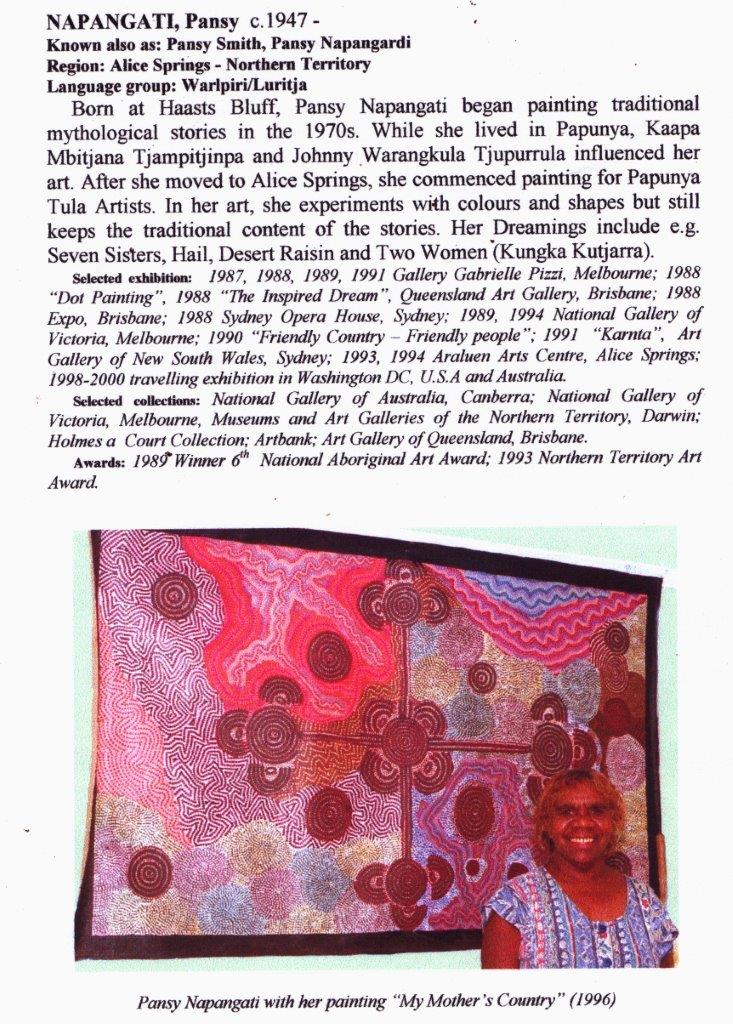
Pansy
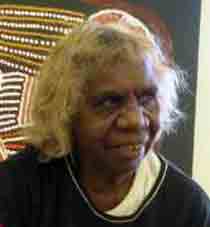
Napangardi Biography
 .png)
Pansy
Napangardi
is
a Australian Aboriginal renowned artist.
Pansy
Napangardi
was
born circa 1948 and grew up at Haast Bluff in Central
Australia.
Pansy
Napangardi
and her sister,
Eunice
Napangardi
(1950-2005)
gain knowledge from the
Johnny Warangkula
Tjupurrula
and
Kaapa Tjampitjinpa
both celebrated artists.
Pansy
Napangardi has been painting from the beginning of the 1970’s.
In the 70's,
Pansy was
one of the major
artists painting
in the
Papunya Tula Artists
and number of
held
exhibitions.
In 1989 Pansy won the prestigious
Australian
National
Aboriginal and Torres Strait Islander Art
Award
also
selected in 1993.
Pansy
Napangardi
work is
in
collections
around
the world including
The Collection
of Arnaud Serval PARIS
(Bird Dreaming).
Biography:
page
258
Aboriginal
Artists Dictionary of Biographies.
Pansy
Napangardi
sister,
Eunice
Napangardi
'Bush
painting Banana Dreaming'
Art Curial Aborigine Australien Collection Peter Los in
Paris
sold for
$68,531(€42,000).
"When
I was a young girl, we always travelled around a lot. We'd
go to a swimming hole, hunting or gathering bush tucker.
Later on, I saw my uncle painting and I asked him, 'Can you
tell me my mother's dreaming? I want to put them down.' "
They told Pansy the stories and showed her in the sand how
to depict them. She practised on paper and later used her
designs to do collages made up with the ininti seeds from
which the women used for making jewellery.
As
Pansy gained experience in this form, she moved into her
forte', acrylic on canvas. Since that time Pansy's paintings
have inspired world acclaim. Today Pansy is considered one
of the foremost artists from Alice Springs.
Although it has been said that Aboriginal women have only
been painting since the 1980's, Pansy states that she, like
her sister Eunice Napangardi, commenced painting much
earlier in the 70’s working for
Papunya Tula Artists.
Pansy
began recording her Dreamings in the early 1970's at the
start of the Papunya Art Movement.
By
observing Johnny Warangkula and Kaapa, two established
artists, Pansy's style emerged. Unlike many other women
artists now associated with the Papunya Tula Artists she did
not serve an apprenticeship, but began painting for herself.
At the time the resources were the province of the senior
initiated men that started the movement. She sold her work
privately through Alice Springs until 1983 when she started
painting with the Papunya Tula Artists on a full-time basis.
Pansy's work gives voice to her traditional beliefs and
symbolises a triumphal cultural statement by the once near
defeated people of the Central Australian Desert.
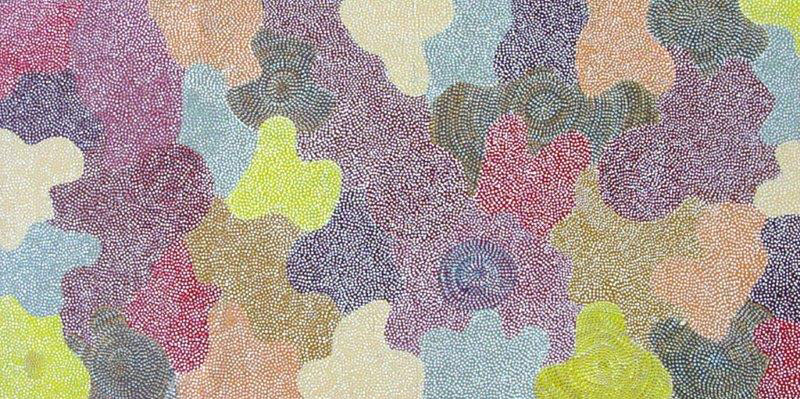
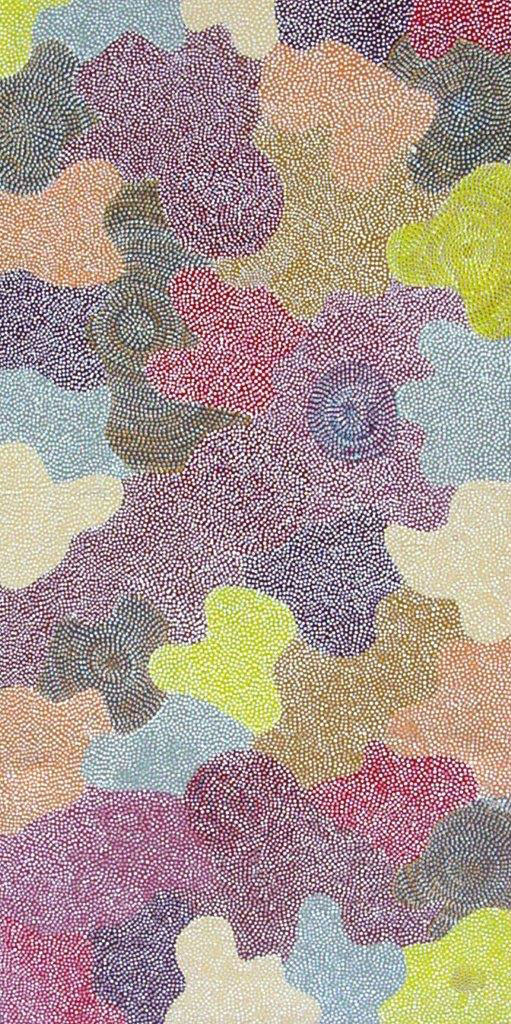
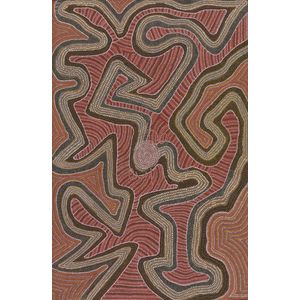
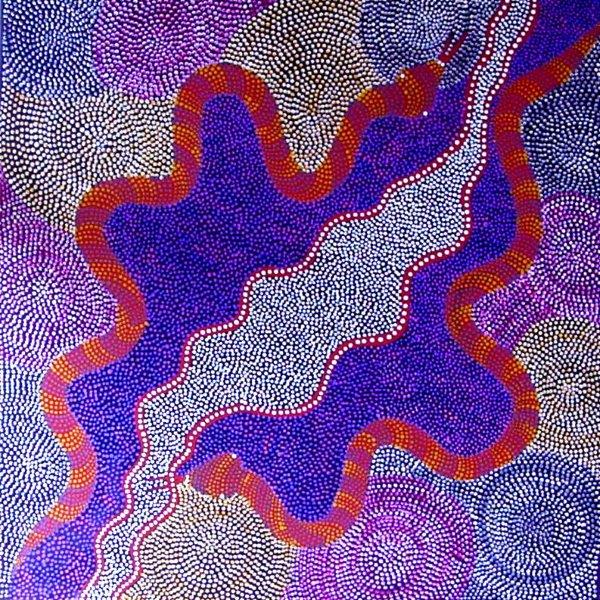
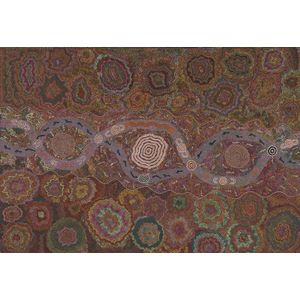
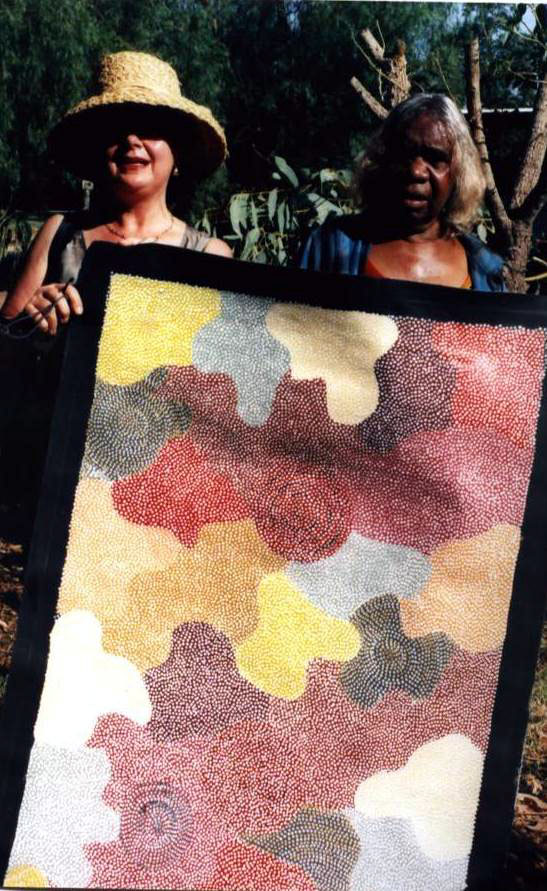
Her paintings are remarkable with their use of colour.
Blues, greens and pinks create a spiritual vigour and
nervous energy that excite the eye. They are refreshing with
their striking vitality and exploring diversity. Her
paintings represent the fertility and glory of her
traditional land, making a statement about the relationship
of her people and the land.
Pansy is an artist who constantly experiments and surprises.
Her close contact with Non-Aboriginal Australians has
progressed her in her search for new rhythms and frontiers
yet she always remains firm within the confines of
Aboriginal traditions.
Her work was seen at the 1988 Brisbane expo as well as the
cover of 'The Inspired Dream', which was published at the
same time. She has had several solo exhibitions, one of them
at the Sydney Opera House, followed by the Gallery Gabrille
Pizzi. Her work is featured in many group exhibitions
including Richard Kelton Foundation collection, 'Mythscapes'
at the National Gallery Canberra and the 'Karnta' exhibition
at the New South Wales Art Gallery.
Pansy moved to Alice Springs in 1989. In 1989 Pansy won
the 6th National Aboriginal Art Award and in 1993 won the
Northern Territory Art Award.
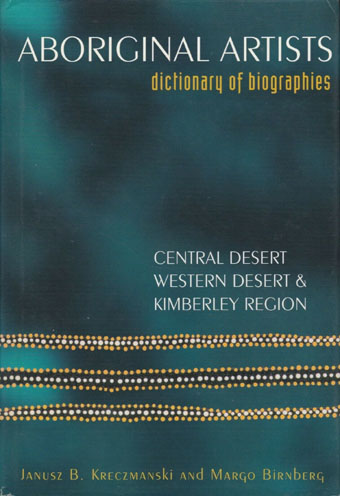
Australian Aboriginal Artists dictionary of
biographies
is a meticulously researched
biographical dictionary hard cover 446
pages book containing over 1000 entries with
colour illustrations of the
artists best work
with a brief biography and relevant exhibition
entries.
Pansy childhood was abundant
with artistic influence and cultural teachings.
Pansy remember her grandparents story-telling Dreamings and
teaching her how to depict them by drawing in the sand.
Pansy learnt her father’s
Dreamings from artist Rennie Robinson which include Bush
Banana, Water Snake, Marlu [Kangaroo], Cockatoo, Bush
Mangoes and Willy Wagtail.
However
Pansy mother’s Dreamings include
Seven Sisters,
Hail, Luritja Country, Desert Raisin and the important
Kungkakutjara 'Two
Women',
Pansy has
learned from her mother’s cousin.
In the 1960’s Pansy moved to
Papunya where she learnt from artists such as Johnny
Warangkula and Kaapa Tjampitjinpa creating Aboriginal
masterpieces. At this stage, Pansy began to paint
progressing to collages which featured Ininti Seeds
[traditionally used in ceremonial jewellery].
Unlike many female Aboriginal
artists Pansy did not apprentice a male painter but she
developed her own unique style independently.
By the 1970’s Pansy was working
and selling her artworks in Alice Springs, later disengaging
from this sphere and re-assumed her painting career in the
early 1980’s. In 1983 Pansy commenced work with Papunya Tula
Artists and by the late 1980’s had established herself as a
leading female artist.
Pansy
Napangardi
is
one of the foremost Australian artists.
From 1960 Pansy gain knowledge
from most celebrated Australian artists
Johnny Warangkula Tjupurrula
(1918-2001)
and
Kaapa Tjampitjinpa
(1920-1989) nonetheless Pansy has developed her own unique
style.
Pansy
Napangardi
has been
a major painter
in the
Papunya Tula movement
in the 70's.
Born in Haasts Bluff c.1940 to a Luritja mother and a
Warlpiri father, Pansy Napangardi was for a long time the
leading female artist of Papunya Tula.
Long before the international art world embraced Emily
Kngwarreye, Pansy Napangardi was growing up in Papunya,
watching the desert art founders as they painted.
As a young woman, Pansy became the first professional female
painter amongst the Luritja and Warlpiri, like Linda Syddick
Napaltjarri was to the Pintupi.
After Pansy got
married (about a decade before Papunya started supplying
women artists with their own painting supplies), Pansy moved
to Alice Springs. She sold her paintings independently until
the mid-1980s.
In 1989, Pansy
returned to Papunya and
won the National Aboriginal Art Award and a solo exhibition
at the Sydney Opera House followed the same year. Another
followed with Gabrielle Pizzi Gallery in Melbourne.
Pansy’s reputation flowered at the very moment that the
attributes of personal style and expressive ability had
become highly prized by collectors. Unfettered by
convention, she developed a technique of applying multi-coloured
dots by dipping the point of her painting stick directly
onto the meniscus of a range of complementary colours. She
became the most prominent female artist at Papunya Tula from
the late 1980s to the mid-1990s, but later reverted to
practising as an independent artist for a range of private
dealers.
Pansy sister, Eunice Napangardi, is a renowned Aboriginal
artist, her youngest brother Brogas Tjapangati paints for
Papunya Tula and her sister, Alice Napangardi, was first
married to Kaapa Tjampitjinpa and later his younger brother
and fellow artist Dinny Nolan. Pansy Napangardi is a unique
artist, whose work deals with her traditional beliefs and
cultural heritage in a truly original style.
AWARDS
1989 – Winner National Aboriginal and Torres Strait Islander
Art Award
Australian
National
Aboriginal and Torres Strait Islander Art
Award
1993
Australian
National
Aboriginal and Torres Strait Islander Art
Award
(selected)
COLLECTIONS
David Henry
George Lascelles, 8th Earl of Harewood England
Harewood House Trust,
England
National Gallery London
The
Collection of Arnaud Serval Paris in France
National London Gallery
Richard Kelton Foundation Santa Monica USA
Artbank Sydney
BBC
UK Collection London
Powerhouse Museum
Tasmanian Museum and National Art Gallery
National Art Gallery of New Zealand
Queensland Art Gallery
Art Gallery of NSW
Museum and Art Gallery Northern Territory
National Gallery of Victoria
National Museum of Australia
Art
Gallery of Western Australia
Queensland Art Gallery
Homes a
Court Collection
Art Gallery of South Australia
The
Kelton
Foundation Santa Monica USA
The
Kerry Stokes
Collection
Donald Kahn Collection USA
Central Collection, Australian National University, Canberra
Lowe Art Museum, University of Miami
Gabrielle Pizzi Collection, Melbourne
National Gallery of Australia, Canberra
Selected
Exhibitions
1987
Queensland National Art Gallery
1988
'Dot Painting The Inspired Dream'
Queensland National Art Gallery
Brisbane
1988,
Sydney Opera House.
1989
Queensland National Art Gallery
1989,
Gallery Gabrielle Pizzi, Melbourne.
1988
Expo, Brisbane
1988
Sydney Opera House, Sydney
1989
National Gallery of Victoria,
Melbourne
1989
Museum and Art Gallery Northern Territory
1989
Gallery Gabrille Pizzi
1990
'Friendly Country - Friendly People'
1991
Gallery Gabrille Pizzi
1991 'Karnta'
Art Gallery of New South
Wales,
Sydney
1991
Queensland National Art Gallery
1992
Harewood House
Trust, England
1993 Araluen Arts Centre, Alice Springs
1993
Museum and Art Gallery Northern Territory
1994
National Gallery of Victoria
Melbourne
1994
Araluen
Arts Centre, Alice Springs
1998
National Gallery London
2000
travelling exhibition in Washington DC USA and Australia, also
Museum & Art Gallery
Northern Territory (Darwin),
Australian National Gallery Canberra,
Victorian Art Centre,
Gallery Gabrielle Pizzi, Melbourne
2007 – St-art European Art Fair, Artists displayed:,
Lucky Morton Kngwarreye, Walangari Karntawarra Jakamarra,
Ningie Nangala, Susie Hunter Petyarre, Andrea Martin
Nungarrayi, Josephine Napurrula, Pansy Napangardi, Galuma
Maymuru, Julie Robinson Nangala, Milminya Dhamarrandji,
Alick Tipoti, Samson Bonson, Eddie Aning-Mirra Kerry,
Haleema Djorlom, Bronwyn Kelly, James Iyuna, Stephen
Kawurlkku, Arts d'Australie, Stephane Jacob, Strasbourg,
France; Papunya Painting – Out of the desert, National
Museum of Australia, Canberra.
2004 – Art Aborigine Pour Tous, Galerie DAD,
Mantes-la-Jolie, France; Kuniya Pilkarti, Gallery Gabrielle
Pizzi, Melbourne; Mythology and Reality – Contemporary
Aboriginal Desert Art from the Gabrielle Pizzi Collection,
Heidi Museum of Modern Art, Melbourne.
2000 Arts d’Australie, Arts d'Australie , Stéphane
Jacob / Galeries Lafayette, Paris; Papunya Tula: Genisus and
Genius, Art Gallery of New South Wales, Sydney.
1999 – Salon Grands et jeunes d’Aujourd’hui, Arts
d'Australie , Stéphane Jacob / Espace Eiffel Branly, Paris.
1997 L’Art des Aborigènes d’Australie, Arts
d'Australie , Stéphane Jacob / Galerie de Stassart,
Bruxelles; L’Art des Aborigènes d’Australie, Arts
d'Australie , Stéphane Jacob / Espace Paul Riquet, Béziers.
1994, Dreamings – Tjukurrpa: Aboriginal Art of the
Western Desert; The Donald Kahn collection, Museum Villa
Stuck, Munich; 1994, Jukurrpa Artists, Australian Heritage
Gallery, Watson, ACT; 1994, Central Australian Aboriginal
Art and Craft Exhibition, Araluen Centre, Alice Springs;
1994, The Eleventh National Aboriginal Art Award Exhibition,
Museum and Art Gallery of the Northern Territory, Darwin;
1994, Power of the Land, Masterpieces of Aboriginal Art,
National Gallery of Victoria.
1993/4, ARATJARA, Art of the First Australians,
Touring: Kunstammlung Nordrhein-Westfalen, Dusseldorf;
Hayward Gallery, London; Louisiana Museum, Humlebaek,
Denmark.
1993, Aboriginal Art Exhibition, Kung Gubunga, Oasis
Gallery, Broadbeach,Qld; 1993, Central Australian Aboriginal
Art and Craft Exhibition, Araluen Centre, Alice Springs;
1993, The Tenth National Aboriginal Art Award Exhibition,
Museum and Art Gallery of the Northern Territory, Darwin;
1993, Ten years of acquisitions,from ANU collection, Drill
Hall Gallery ACT; 1993, Central Australian Aboriginal
Art and Craft Exhibition, Araluen Centre, Alice Springs.
1991/92, Friendly Country, Friendly People, Touring
Exhibition, through Araluen Centre, Alice Springs.
1991, Australian Aboriginal Art from the Collection
of Donald Kahn, Lowe Art Museum, University of Miami, USA;
1991, Aboriginal Art and Spirituality, High Court, Canberra;
1991, Aboriginal Women's Exhibition, Art Gallery of New
South Wales, Sydney.
1990, l'ete Australien a' Montpellier, Musee Fabre
Gallery, Montpellier, France.; 1990, National Gallery of
Modern Art, Rome.
1989, Mythscapes, Aboriginal Art of the Desert,
National Gallery of Victoria; 1989, The Sixth National
Aboriginal Art Award Exhibition, Museum and Art Gallery of
the Northern Territory, Darwin.
1988, The Inspired Dream, QAG, Brisbane.; 1988,
Gallery Gabrielle Pizzi, Melbourne.
1988, ANCAAA and Boomalli, Boomalli Aboriginal
Artists Ko-operative, Sydney.
1987, The Fourth National Aboriginal Art Award
Exhibition, Museum and Art Gallery of the Northern
Territory, Darwin.
1987, Gallery Gabrielle Pizzi, Melbourne.
Literature
BIBLIOGRAPHY
Source
& FURTHER
REFERENCES
Australian Aboriginal Art from
the Collection of Donald Kahn, 1991, Lowe Art Museum,
University of Miami, USA
Caruana, W., 1993, Aboriginal Art, Thames and Hudson,
London. (C)
Crossman, S. and Barou, J-P. (eds), 1990, L'ete Australien a
Montpellier: 100 Chefs d'Oevre de la Peinture Australienne,
Musee Fabre, Montpellier, France. (C)
Crumlin, R., (ed.), 1991, Aboriginal Art and Spirituality,
Collins Dove, North Blackburn, Victoria. (C)
Isaacs, J., 1989, Australian Aboriginal Paintings, Weldon
Publishing, New South Wales.
Johnson, V., 1994, The Dictionary of Western Desert Artists,
Craftsman House, East Roseville, New South Wales. (C)
1993, Aratjara, Art of the First Australians: Traditional
and Contemporary Works by Aboriginal and Torres Strait
Islander Artists, exhib. cat. (conceived and designed by
Bernard Luthi in collaboration with Gary Lee), Dumont,
Buchverlag, Koln. (C)
Ryan, J., 1989, Mythscapes Aboriginal Art of the Desert from
the National Gallery of Victoria, exhib. cat., National
Gallery of Victoria, Melbourne. (C)
West,
M. (ed.), 1988, The Inspired Dream, QAG, Brisbane.
1988, ANCAAA and Boomalli, exhib. cat., Boomalli Aboriginal
Artists Ko-operative, Sydney. (C)
1991, Aboriginal Women's Exhibition, exhib. cat., Art
Gallery of New South Wales, Sydney.
Bardon, Geoffrey; Ryan, Judith; Pizzi, Gabrielle; Stanhope,
Zara., Mythology and Reality – Contemporary Aboriginal
Desert Art from the Gabrielle Pizzi Collection, Heidi Museum
of Modern Art, Melbourne.
Johnson, Vivien.(Editor), Papunya Painting: Out of the
Desert, National Museum of Australia, Canberra, 2007.
Pansy close contact with
Non-Aboriginal Australians has progressed her in her search for new
rhythms and frontiers yet she always remains firm within the confines of
Aboriginal traditions.
Pansy Napangardi began working from 1960 and as an independent
artist working for herself since the early 70's. The
resources of Papunya Tula Artists at this time were exclusively the
province of the senior initiated men who began the painting enterprise.
Pansy independently sold her works in Alice Springs. She worked in this
manner for about five years followed by a long break. In 1983 she
resumed painting, working for Papunya Tula Artists.
Pansy Napangardi
paintings are is in
high demand and she is represented in major public collections
throughout the world.
During the late 80's Pansy Napangardi emerged as Papunya
Tula's foremost women artist. Her work was included in the company's
display at the 1988 Brisbane Expo and also featured on the cover of The
Inspired Dream catalogue of a major survey of Aboriginal Art shown at
the same time at the Queensland Art Gallery.
Pansy
has had number of solo
exhibitions. The first one was at the Sydney Opera House in September
1988 promoted by the Centre for Aboriginal Artists (for whom she still
paints for occasionally). The second showing occurred at the Gallery
Gabrielle Pizzi in Melbourne in May 1989 promoted by Papunya Tula
Artists.
In 1989
Pansy Napangardi
won the sixth National Aboriginal Art Award. She showed
again at the Gallery Gabrielle Pizzi in late 1991 and also in Brisbane
with EUNICE Napangardi in early 1992. Her work has appeared in several
major surveys of Aboriginal art, including 'Mythscapes' at the National
Gallery of Victoria in 1989 and 'Karnta', a show of Aboriginal women's
work at the Art Gallery of NSW in 1991.
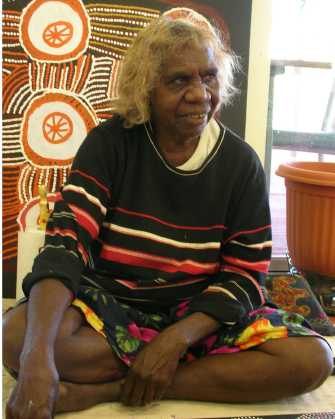
Pansy Napangardi is
considered one of the foremost Australian artists. Pansy is a major painter in what is today known as the
Papunya Tula
movement. Although it
has been said that Aboriginal women have only been painting since the
1980's, Pansy states that she, like her sister
Eunice Napangardi
(c1950-2005),
commenced painting earlier.
Pansy Napangardi
(a Luritja/Warlpiri decent)
was born at
Haasts Bluff
in the late 1940
during the early years of mission
settlement
and was moved with the
settlement to
Papunya
in the early
1960s.
She is from the
Warlpiri
language group. Pansy is one of the rare women associated with Papunya Tula who did not
serve an apprenticeship with the men. She sold her works independently
in
Alice Springs
at first, but during the
1980s
she became the pre-eminent woman painter at Papunya Tula, winning the
National Aboriginal & Torres Strait Islander
Art Award
(NATSIAA)
in 1989. She is
associated with the Jukurrpa group of women artists in Alice Springs
where she lives today.
From 1960 Pansy lived in Papunya where she
observed older artists like Johnny WARANGKULA and KAAPA Tjampitjinpa.
Pansy Napangardi began recording her Dreaming in the early 1970's at the
start of the Papunya Art Movement. By observing Johnny Warangkula and Kaapa, two established
artists, Pansy's developed her own
unique style.
Pansy Napangardi
began
working for herself from the early 70's. Pansy independently sold her works in Alice Springs
and in 1983 she
resumed painting, working for Papunya Tula Artists.
During the late 80's Pansy Napangardi emerged as Papunya
Tula's foremost women artist. Her work was included in the company's
display at the 1988 Brisbane Expo and also featured on the cover of The
Inspired Dream catalogue of a major survey of Aboriginal Art shown at
the same time at the Queensland Art Gallery. She has had two solo
exhibitions. The first one was at the Sydney Opera House in September
1988 promoted by the Centre for Aboriginal Artists (for whom she still
paints for occasionally). The second showing occurred at the Gallery
Gabrielle Pizzi in Melbourne in May 1989 promoted by Papunya Tula
Artists.
Pansy Napangardi work was
seen at the 1988 Brisbane expo as well as the cover of 'The Inspired
Dream', which was published at the same time. She has had several solo
exhibitions, one of them at the Sydney Opera House, followed by the
Gallery Gabrille Pizzi. Her work is featured in many group exhibitions
and is represented in collections around the world
including Richard Kelton Foundation collection, 'Mythscapes' at the
National Gallery Canberra and the 'Karnta' exhibition at the New South
Wales Art Gallery.
Pansy
showed
again at the Gallery Gabrielle Pizzi in late 1991 and also in Brisbane
with EUNICE Napangardi in early 1992. Her work has appeared in several
major surveys of Aboriginal art, including 'Mythscapes' at the National
Gallery of Victoria in 1989 and 'Karnta', a show of Aboriginal women's
work at the Art Gallery of NSW in 1991.
Pansy
Napangardi
Style

Pansy's
work gives voice to her traditional beliefs and symbolizes a triumphal
cultural statement by the once near defeated people of the Central
Australian Desert. Her paintings are remarkable with their use of colour. Blues, greens and pinks create a spiritual vigor and nervous
energy that excite the eye. They are refreshing with their striking
vitality and exploring diversity.
Pansy Napangardi paintings
often represent the fertility and glory of her traditional land, making a
statement about the relationship of the her people and the land. Pansy
is an artist who constantly experiments and surprises. Her close contact
with Non-Aboriginal Australians has progressed her in her search for new
rhythms and frontiers yet she always remains firm within the confines of
Aboriginal traditions.
Pansy Napangardi
has a son and four other adopted children, the youngest
of whom she now lives with in Alice Springs. Pansy attends literacy
classes at IAD with many of the other women from the Tjukurrpa painting
group. Her sister Alice Napangardi is married to artist Dinny NOLAN and
lives in Papunya. Her younger brother BROGAS TJAPANGATI also paints for
the Papunya Tula Artists and the Aboriginal Desert Art Gallery.
Pansy father and grandfather are Warlpiri tribesmen and were born at
Pikilyi (Vaughan Springs), west of Papunya. Pansy paints; Bush Banana,
Water Snake, Seven Sisters, Hail, Desert Raisin and Two Women, Kangaroo,
Cockatoo, Bush Mangoes and Willy Wagtail. Her mother who was Luritja was
born at the site of Illpili. Pansy mother's cousin taught Pansy the
Dreamings from her mother's side of the family.
Napangarti’s grandparents first showed her how to depict her inherited
stories 'Dreamings' by drawing them in the sand. Napangarti was born in
Haast Bluff in central Australia. She bases her work on the traditional
Dreamings handed down through her family. Unlike other aboriginal women
artists, Napangarti did not serve an apprenticeship by working on the
paintings of her male relatives. Instead, she forged her own distinctive
style in the 1970s and is now represented in major collections across
the world. Pansy recalls her grandmother
and grandfather telling her stories about her Dreamings and also showing
her how to depict them by drawing them in the sand. She practiced on
paper and later used her designs to do collages comprised of glue and
the 'ininti' seeds from which the women usually made necklaces.
Warlpiri artist, Pansy
Napangardi moved to Alice Springs in 1989. "When I was a young girl we
always travelled around a lot. We'd go to a swimming hole, hunting or
gathering bush tucker. Later on I saw my uncle painting and I asked him,
'Can you tell me my mother's dreaming? I want to put them down.' " They
told her the stories and showed her in the sand how to depict them. She
practised on paper and later used her designs to do collages made up
with the 'ininti' seeds from which the women used for making jewellery. As
she gained experience in this form, she moved into her forte', acrylic
on canvas. Since that time Pansy's paintings have inspired world
acclaim.
|
 World’s Local Fine Art