|
Katie
Kemarre
Biography
.png)
If you
love unique, beautiful works of fine art,
consider authentic Aboriginal paintings
of
impeccable
provenance
by the
Utopia
artist,
Katie
Morton Kemarre.
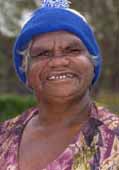
Born 1943, Katie Morton Kemarre is a renowned Australian
Aboriginal artist.
Katie Morton
artistic career began in the early 1970's with the Utopia Women's Batik
Group.
Katie
Morgan
Kemarre
participated in the
Utopia
'A Picture Story Exhibition' by 88 Utopian
artists, which toured Australia and internationally.
In 1988, during “A Summer Project”
painting from Utopia in 1988-89,
Katie gained further artistc recognition painting solely on canvas in acrylics.
Katie
Morton Kemarre
bird's-eye-view
mysterious and almost hypnotic
landscapes,
have the sheer physical presence of much contemporary work of fine
art.
Using an
aerial perspective,
Katie Morton creates
unique,
modern, state-of-the-art,
distinctively abstract, beautiful
paintings,
that build
up the multi-dimensional topography of depth and space of the
Utopia country
and the seasonal changes.
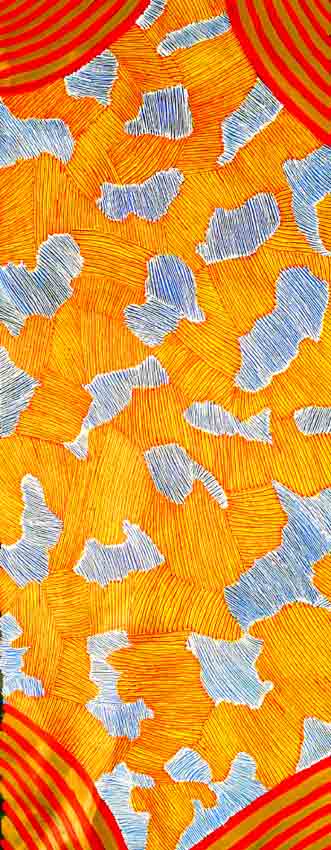
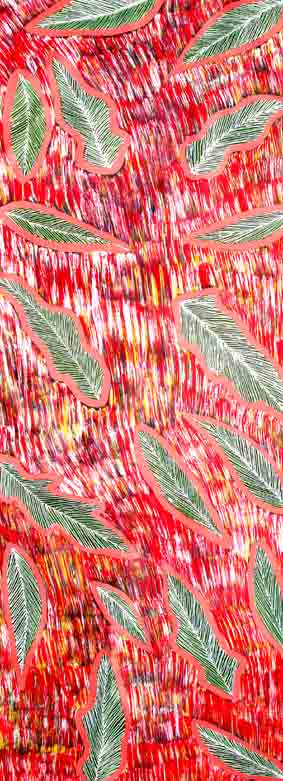
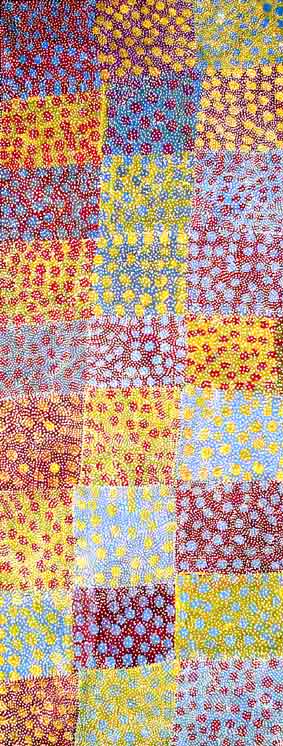
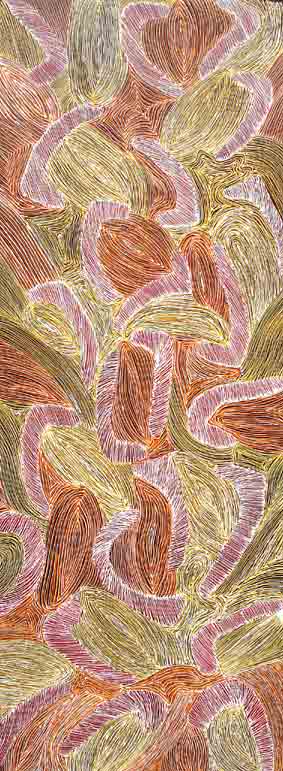
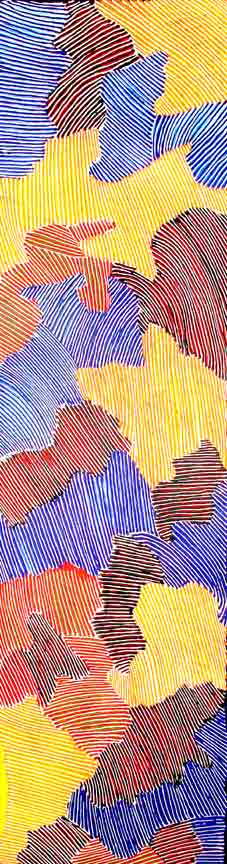 Altyerre
MB031682,
Acrylic on linen on board,
Image size: 95 x 35 cm,
Altyerre
MB031682,
Acrylic on linen on board,
Image size: 95 x 35 cm,
Framed
size: 135 cm x 45 cm - Price: $1,800
Enquire
Katie Kemarre paintings
in the
Museum of Contemporary Art Australia
(MCA)
MCA (8
Sep-7 Nov 1993)
Artists:
Katie Kemarre,
Lucky Kngwarreye, Audrey Kngwarreye, Hazel Kngwarreye,
Janice Kngwarreye, Lilly Kngwarreye, Wally Pwerle.
Katie Morton work is represented at Art
Gallery of NSW, ArtBank, Art
Gallery of Western Australia, Museum
of Victoria,
Homes a Court, Flinders
University and
international collections: Richard
Kelton Foundation Santa Monica, World
Vision.
Katie Morton
Kemarre was
married to
Greeny Purvis Petyarre
(1930-2010), a well-known Australian Aboriginal artist.
Katie Morton and
Greeny Purvis Petyarre
daughter
Maureen Purvis (Kngwarreye)
is also a recognized artist as well as her aunt
Emily Kngwarreye
(1910-1996).
Katie Morton Kemarre gentle and beautiful paintings depict the
ancient country and the
Utopia Northern Territory
homelands. Within the lines of the land is where the bush yam is found, ground
down and made into a paste which they apply to the exterior of their body to
heal.
Katie Morton work is represented at Art
Gallery of NSW, ArtBank, Art
Gallery of Western Australia, Museum
of Victoria, Homes a Court, Flinders
University and international collections: Richard
Kelton Foundation Santa Monica, World
Vision.
Katie Morton Kemarre is
successful in the
World Art Market,
her
hypnotic
paintings are
keenly sought after by
international buyers.
Katie Morton is
an Alyawarre woman from Utopia Station, approximately 250km north-east of Alice
Springs. In accordance to traditional law the responsibility for the Dreaming
has been passed down to Katie from her ancestors, responsible for ensuring to
persevere the traditional traditions.
Katie is
one of the traditional custodians for the Altyerre Dreaming, some 263kms north
of Alice Springs, Australia.
The Alyawarre, also spelt Alyawarr and also known as the Iliaura, are an
Aboriginal people, language group, from the Northern Territory.
Katie has also been involved in wood figures
carvings.
Subject(s):
Antarrengeny Country, Camp Scenes, Apeng (Kurrajong)
Dreaming, Awely (Women’s Ceremony and body paint designs)
The background designs represent
Kathleen’s country Antarrengeny.
Kurrajong Seed
Dreaming is
the Amern Ngkweyang story of the seed from the Aping desert kurrajong tree.
The ancient Dreamtime story belongs to the Ngkweyang (the
aping seed)
in the heart of Alyawarr land (Kathleen’s country) Antarrengeny north east of
Alice Spring.
Language: Alyawarr
Skin Name: Kemarre (pronounced Ke-mah-ra, also spelled Akemarr)
Language Group: Alyawarr
Country: Antarrengeny, Utopia Region, N E of Alice Springs
Medium: Silk Batik, Acrylic on Canvas, Sculpture
Armen
means
food
-
Ngkweyang
is
Kurrajong medicine tree
seeds.
Kurrajong
Seed Dreaming
The
important Dreaming for Katie depicted in her work
is the
Kurrajong medicine tree
Dreaming
- Merne Ngkweyang (Kurrajong Seed).
Katie
designs
are inspired by
beautiful
Kurrajong flowers,
seeds and leaves.
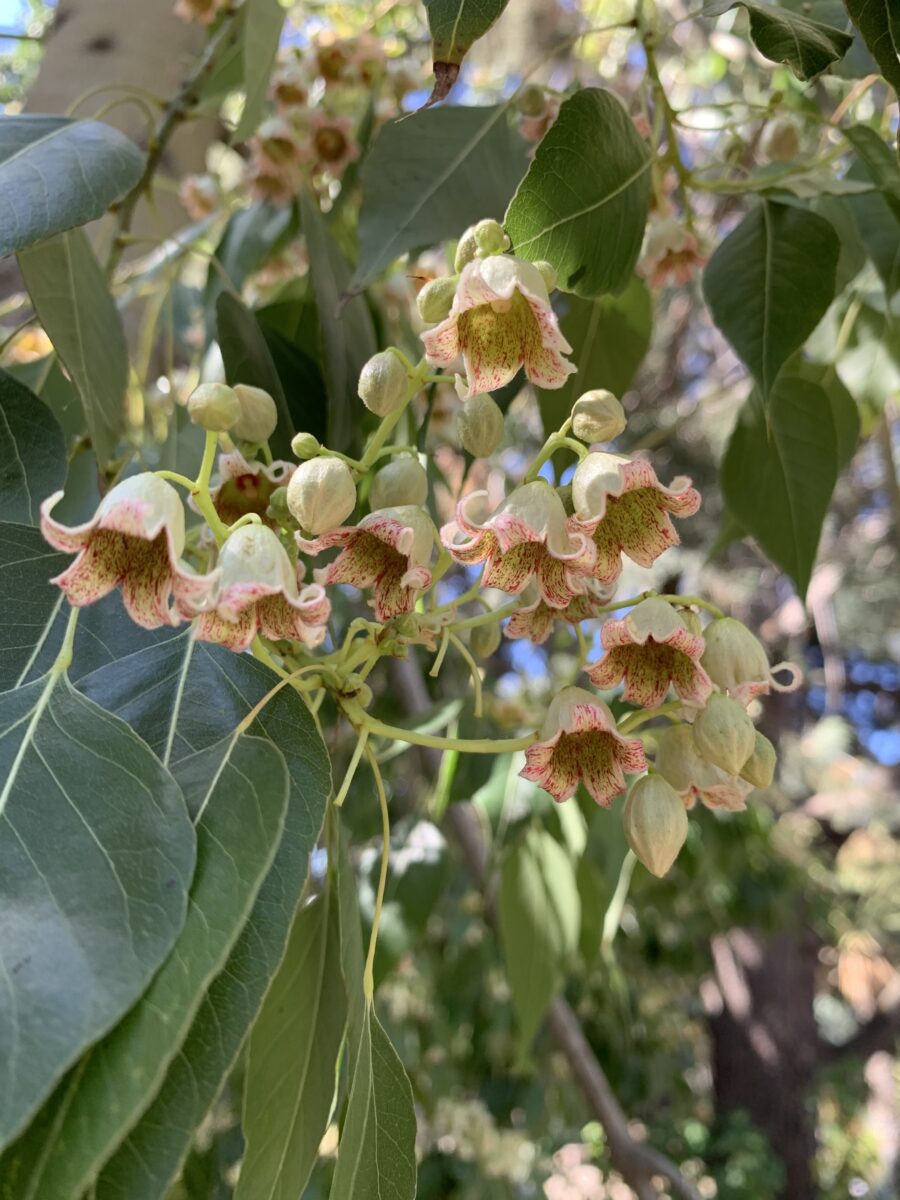
The
Kurrajong
Tree,
genus Brachychiton belongs the family Sterculeaceae, and all the
species are native to Australia. The ones in cultivation in California
are trees, but there are also some species which grow as shrubs. Some
kinds develop fat trunks, and are sometimes referred to as “bottle
trees” or “Australian Bottle Trees”. One of these is Brachychiton
populneus.
The
Kurrajong Tree
fruit
is a
woody, boat-shaped pod, about 7 cm long, which is at first green but
ripens black, splitting down one side to release about 20 yellow hairy
seeds.
The hairs on the seeds can cause
intense irritation to sensitive skin. The kurrajong occurs naturally in
all the major climatic divisions of the State.
Ngkweyang is an important and nutritious food source the Aboriginal people would collect these seeds,
burn them to remove small hairs, and grind them into a paste for making
damper (bread) this practice is not so habitual now.
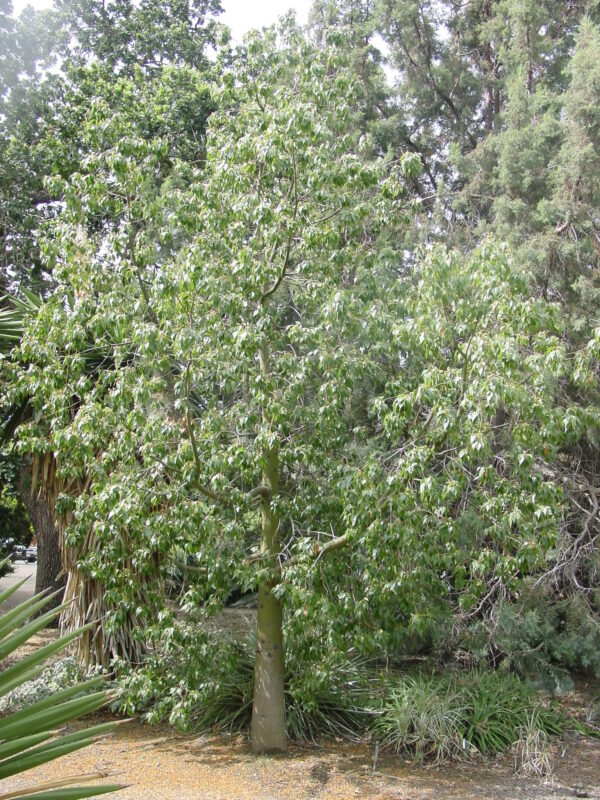
Brachychiton populneus has
a wide distribution in the eastern part of Australia, occurring in both inland
and coastal areas.
It is a very beautiful tree, with glossy leaves resembling those of poplars (the
name of the species alludes to this, Populus being the genus of the
poplars).
The stout green trunk is one of its points of appeal, though it is not as
swollen and bottle-like as that of the related Brachychiton rupestris,
which shares its common name of bottle tree.
The crown of Brachychiton populneus is dense, and the foliage is
evergreen, making it a popular choice as a shade tree. Mature trees can reach
as much as 40 to 45 feet or more in height, though often they are less than
this.
This species does well in mild desert climates such as that of southern Arizona,
and it is often used as a street tree there. Despite the fact that it comes
from a part of Australia where the rainfall is concentrated in summer, it grows
very well in our winter-rainfall California climate.
The flowers of Brachychiton populneus are not large or showy, but they
are attractive when viewed up close. They lack petals, but the fused sepals
look petal-like.
The flowers are bell-shaped and flare into 5 pointed and curled-back tips. They
are pale on the outside, ranging in color from white or greenish-white to cream
to pale pink, and within they are attractively speckled with red or
purplish-red. The seeds are contained within dangling follicles which resemble
little canoes made of tough leather.
COLLECTIONS
Art Gallery of New South Wales
Museum Art Gallery Northern
Territory Darwin
Richard Kelton Foundation, Santa
Monica, USA
Flinders University, Adelaide, South
Australia
National Gallery
of Victoria Melbourne
Art Gallery of
Western Australia Perth
Art Gallery of
South Australia Adelaide
National Gallery
of Australia Canberra
Queensland Art
Gallery Brisbane
Museum Victoria, Melbourne
World Vision
Museum
Kunstpalast ,
Germany
ArtBank Sydney
Holmes à Court Gallery and gallery Collection Perth
Mbantua Museum Gallery Permanent Collection,
Alice Springs NT
and private collections around the world
Women Ceremony
-
Makeup Ceremony
The linear designs in
Kathleen’s
painting represent women
ceremony, their travel
and the designs of body paint (Awelye).
In 21st century language: women use makeup.
Aboriginal Women
manufacturer their
own
natural products to paint their body for the ceremonies.
The paints are the colored products intended to alter women
appearance are are decorative cosmetics.
Widely
advertised the Mineral makeup
(recently discovered) has been
used by
Aboriginal women for over 60000 years.
In Europe Cosmetics have been in use for
thousands of years
using
ceruse (white lead), to cover the face during the
Renaissance, (blindness caused by the
mascara
Lash Lure during the early 20th century).
Romans and
Ancient Egyptians used cosmetics containing poisonous
mercury and often
lead. However
Aboriginal Women Cosmetics include
only natural earth
grounded Powders (red and yellow
clays (ochre ),
charcoal and
Ash.
Aboriginal Women
apply paint
on the whole body,
with a tool that is flat soft padding stick called (typale)
like a
Makeup
brush.
They paint their body designs on the
faces and also,
used the body paint, onto
Women chest, breasts, arms as well as their thighs.
Each woman can play
a makeup Artist and takes her turn to be “painted-up”. During
the Ceremony
Aboriginal Women sing the songs associated with their (awely).
Women perform (awely)
ceremonies to feel good and to demonstrate respect for
themselves, their country and the total
well-being and health of the community as well as their own.
Aboriginal Woman have been applying natural
grounded
earth
powders
makeup
cosmetic
for over 6000 years.
However the first
archaeological evidence of cosmetics usage was found in
Egypt
around
3500 BC during the
Ancient Egypt times with some of
royalty owning make-up, such as
Nefertiti,
Nefertari, mask of
Tutankhamun.
In Europe in the
Middle Ages women like a pale-skinned complexion, which was
achieved through either applying pastes of lead, chalk, or flour, or by
bloodletting, also put white lead pigment that was known as
ceruse (white lead) on
their faces to appear to have pale skin. Cosmetic use was frowned upon at many points in Western history.
For example, in the 19th century, make-up was used primarily by
prostitutes, and
Queen Victoria publicly declared makeup improper,
vulgar, and
acceptable only for use by
actors.
European
Women in
the 19th century liked to be thought of as fragile ladies. They compared
themselves to delicate flowers and emphasized their delicacy and
femininity. They aimed always to look pale and interesting. Sometimes
ladies discreetly used a little rouge on the cheeks, and used "belladonna"
to dilate their eyes to make their eyes stand out more.
Make-up was
frowned upon in general especially during the 1870s when social
etiquette became more rigid.
Actresses however were allowed to use make up and famous beauties such
as
Sarah Bernhardt and
Lillie Langtry could be powdered. Most cosmetic products available in the world
were still either chemically dubious, or found in the kitchen amid food
colorings, berries and
beetroot.
By the middle of the 20th century,
cosmetics were in widespread use by women in nearly all
industrial societies
around the world.
In ancient times aboriginal people are hunting
and gathering for bush food.
They are pictured carrying traditional implements including boomerangs,
coolamons (carved wooden bowls) and digging sticks. Traditionally these were
made of hard wood such as mallee or mulga; the sticks heavy enough to club
smaller animals and doubled as a prod for cooking on the fire.
In the coolamons, edible grubs can be seen along with other bush
fruits and edible seeds (ntang ngkweyang) from the Kurrajong tree that have been
collected. The people are surrounded by Kurrajong trees which are denoted by the
brown seed pods found on their branches.
There is an ancient Dreamtime story belonging to the Kurrajong
seed which
lies in the heart of Alyawarr land in Katie’s country, Antarrengeny, north east
of Alice Springs. It was an important and nutritious food source. Not a habitual
practice now, the Aboriginal people would collect these seeds, burn them to
remove small hairs, and grind them into a paste for making damper (bread).
Katie Kemarre and her people still collect
many traditional bush foods today with readymade tools such as poles and empty
flour drums.
Every so often, Katie and other members of her community paint
camp scenes like this. In fact, there was a period in the 1990's where they were
quite prevalent. They have been described as naive depictions or primitive
portrayals of traditional bush life. Katie's style of painting is generally
fluid; that is not set on any one particular style or subject. She
often features the Kurrajong seed which is an important Dreamtime story for the
people of her country but there is no strict style that she emulates. In recent
months we see her move back to more traditional symbols and images and we are
happy to highlight this unique artwork.
EXHIBITIONS
1989 Utopia Women’s Paintings, the First Works On Canvas, A Summer
Project, 1988-89, S.H. Ervin Gallery, Sydney
1988-89 Exhibition
Catalogue Heytesbury Holdings, Brody
Homes a Court Gallery Collection Perth
1990, Utopia: Picture Story;
Homes a Court Gallery Collection, Pert
1990 Utopia A Picture Story, an exhibition of 88 works on silk from the
Robert Holmes a Court Collection by Utopian Artists which toured Eire
and Scotland.
1991 The Eighth National Aboriginal Art Award Exhibition, Museum and Art
Gallery of the Northern Territory, Darwin
1991 Aboriginal Women’s Exhibition, Art Gallery of New South Wales,
Sydney
1991 Aboriginal Women’s
Exhibition Catalogue
Art Gallery of New South Wales,
Sydney
1993 The Tenth National Aboriginal Art Award Exhibition, Museum and Art
Gallery of the Northern Territory, Darwin
1994 Yiribana Exhibition Catalogue
Art Gallery of New South Wales,
Sydney
1994 Yiribana, Art Gallery of New South Wales, Sydney 2002 Group
Exhibition, Mbantua Gallery, Alice Springs NT
2002 Art and Soul Gallery, Nashville, Tennessee, USA
2002 'The Cove Gallery' Portland, Oregon USA
(Benefit - OHSU Heart Research Centre)
2002 Urban Wine Works, Portland, Oregon USA (OHSU Heart Research Centre)
2002 Mary's Woods, Portland, Oregon USA (OHSU Heart Research Centre)
2003 New City Merchants, Knoxville, Tennessee USA
2003 Art and Soul Gallery, Nashville, Tennessee USA
2003 'The Cove Gallery' Portland, Oregon USA
(OHSU Heart Research Centre)
2003 Contemporary Aboriginal Art Event,
2003
Umpqua Bank,
Portland, Oregon USA (OHSU Heart Research Centre)
2003 Mary's Woods, Portland Oregon USA (OHSU Heart Research Centre)
2003 Art From Dreamtime, Portland Art Museum,
Portland Oregon USA (OHSU Heart Research Centre)
Feb 2004 ‘Last of the 20th Century’, Mbantua Gallery, Alice Springs
Aug-Sep 2004 Gallery USA exhibition, Portland
USA
2004
Nashville,
Knoxville, Greenwich USA
2004
New York Gallery, New York
USA
Bibliography
Literature Source
& FURTHER REFERENCES
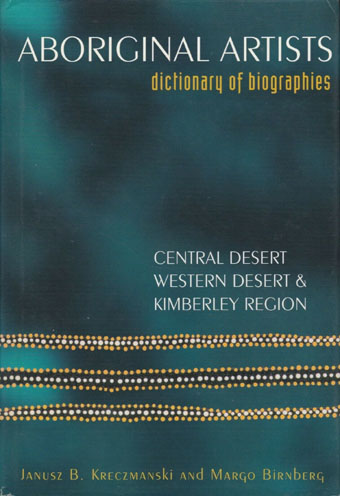
Australian
Aboriginal Artist dictionary of biographies
Central Desert, Western Desert & Kimberley
Region
Kreczmanski, Janusz B & Birnberg,
Margo
JB
Publishing Australia, Marleston, 2004
Brody, A. (1989) Utopia Women's Paintings, The First Works on
Canvas, A Summer Project 1988-89, exhib.cat., Heytesbury Holdings, Perth, WA
Brody, A. (1990) Utopia: a Picture Story, 88 Silk Batiks from the
Robert Holmes à Court Collection, Heytesbury Holdings, Perth, WA
Aratjara (1993) Art of the First Australians: Traditional
and Contemporary Works by Aboriginal and Torres Strait Islander Artists, exhib.
Cat. (conceived and designed by Bernard Luthi in collaboration with Gary Lee),
Dumont, Buchverlag, Koln
Neale, M. (1994) Yiribana, exhib.cat, Art Gallery of New South
Wales, Sydney, NSW
Art Gallery of NSW (1991) Aboriginal Women's Exhibition, exhib.
Cat, Art Gallery of New South Wales, Sydney, NSW
Brody, A, 1989, Utopia Women’s Paintings: the First Work on Canvas, A
Summer Project 1988-89., cat., Heytesbury Holdings, Perth Brody, A.,
1990, Utopia: a Picture Story, 88 Silk Batiks from the Robert Holmes a
Court Collection, Heytesbury Holdings Ltd, Perth; 1993, Aratjara, Art of
the First Australians: Traditional and Contemporary Works by Aboriginal
and Torres Strait Islander Artists, exhibition Cat. (conceived and designed
by Bernard Luthi in collaboration with Gary Lee), Dumont, Buchverlag,
Koln. Neatle, M., 1994, Yiribana, exhib.cat., Art Gallery of New South
Wales, Sydney 1991, Aboriginal Women’s Exhibition, exhibition Cat. Art
Gallery of New South Wales, Sydney,
NATSIVAD Data Base;
1994, Yiribana Exhibition catalogue, Art
Gallery of New South Wales, Sydney; 1991, Aboriginal Women’s
Exhibition Cat.
Art Gallery of NSW, Sydney;
Brody, A, 1989, Utopia Women’s Paintings: First Work on Canvas, A
Summer Project;
1988-89., cat., Heytesbury Holdings,
Homes a Court Collection
Perth Brody, A.;
1990, Utopia: Picture Story;
Holmes a Court Collection.
"Aboriginal
Artists of the Western Desert - A Biographical Dictionary" by Vivien
Johnson, published by Craftsman House 1994,
"The
Oxford Companion to Aboriginal Art and Culture"
edited by Sylvia Kleinert and Margo Neale published by OUP 2000, “Australian
Aboriginal Artist Encyclopedia”
– dictionary of biographies”
Kreczmanski, Janusz B & Birnberg, Margo (eds.): Aboriginal Artists:
Dictionary of Biographies: Central Desert, Western Desert & Kimberley
Region (JB Publishing Australia, Marleston, 2004).
Brody, A. 1989 Utopia women’s Paintings: the First Works on Canvas, A
summer Project, 1988-89 exhib. Cat. Heytesbury Holdings, Perth
Brody, A. 1990 Utopia, a picture Story, 88 Silk Batiks from the
Robert
Homes
a Court Gallery and gallery Collection,
Heytesbury Holdings LTD Perth NATSIVAD database.
|