.png)
Bobby West
Tjupurrula
B.
1958
Ancient culture of 60 thousand
years gave the World its most exciting Contemporary Art |
|
If you
LOVE quality
Art of
impeccable
provenance,
the
art
you want is at
Galeria Aniela |
|
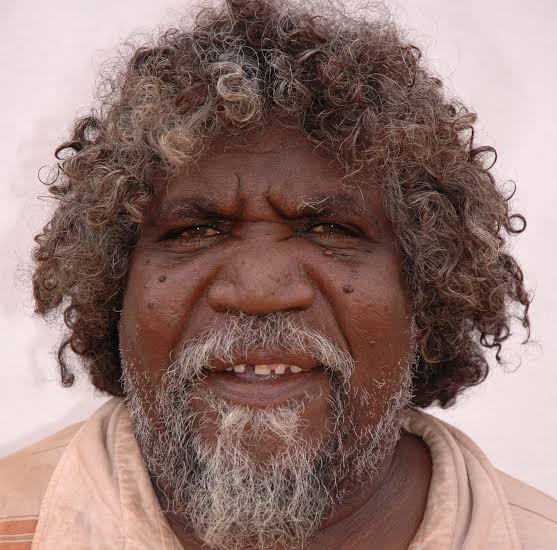 Bobby
West Tjupurrula
is
the son of Freddy West Tjupurrula, one of the original
shareholders of Papunya Tula Artist. Bobby West is a well-known
Australian Aboriginal artist. He
won many
Art Awards
including 1999 collaborative
National Museum Berlin
Germany,
2001
Alice Springs Art Award,
2002
National Aboriginal and Torres Strait Islander
Art Award,
2003
Art in Residency Fireworks Gallery
Brisbane,
2006
'Rising Stars'
Gallery Gabrielle Pizzi,
2011
Art in Residency Fireworks Gallery,
2011
National Aboriginal
Art Award.
Bobby West
Tjupurrula work is held in
collections
around the world. Bobby West
Tingari Cycle
painting
sold for $18,600
and
Yunala for
$18,300. Bobby
West Tjupurrula
is
the son of Freddy West Tjupurrula, one of the original
shareholders of Papunya Tula Artist. Bobby West is a well-known
Australian Aboriginal artist. He
won many
Art Awards
including 1999 collaborative
National Museum Berlin
Germany,
2001
Alice Springs Art Award,
2002
National Aboriginal and Torres Strait Islander
Art Award,
2003
Art in Residency Fireworks Gallery
Brisbane,
2006
'Rising Stars'
Gallery Gabrielle Pizzi,
2011
Art in Residency Fireworks Gallery,
2011
National Aboriginal
Art Award.
Bobby West
Tjupurrula work is held in
collections
around the world. Bobby West
Tingari Cycle
painting
sold for $18,600
and
Yunala for
$18,300. |
|
|
 |
|
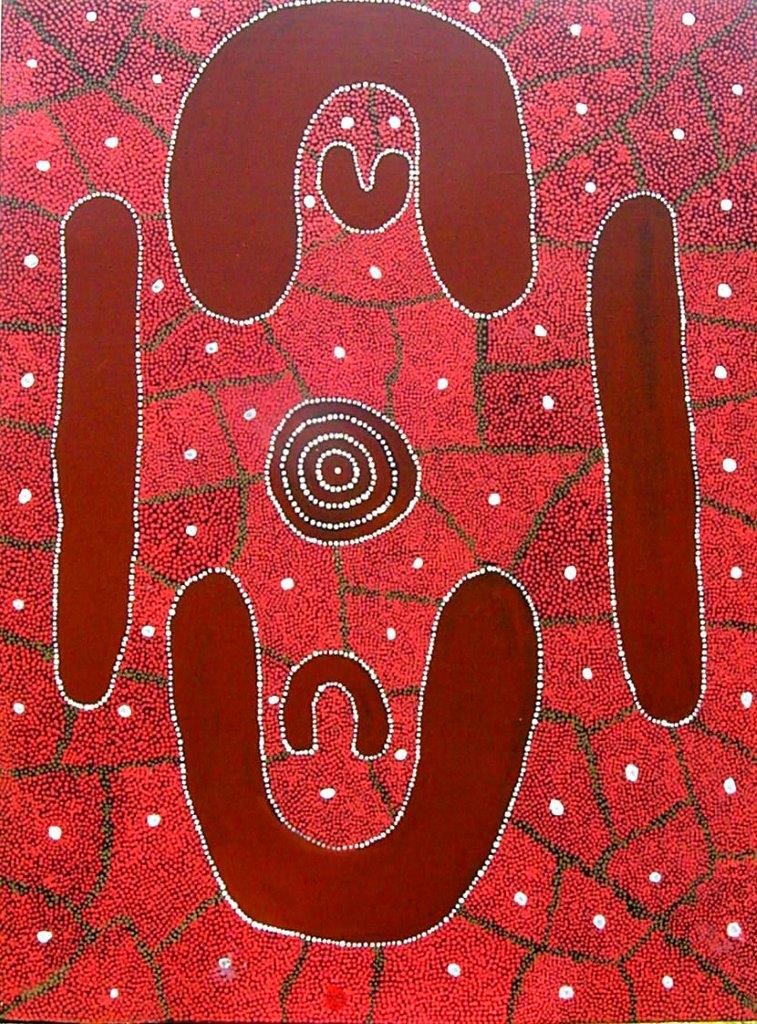
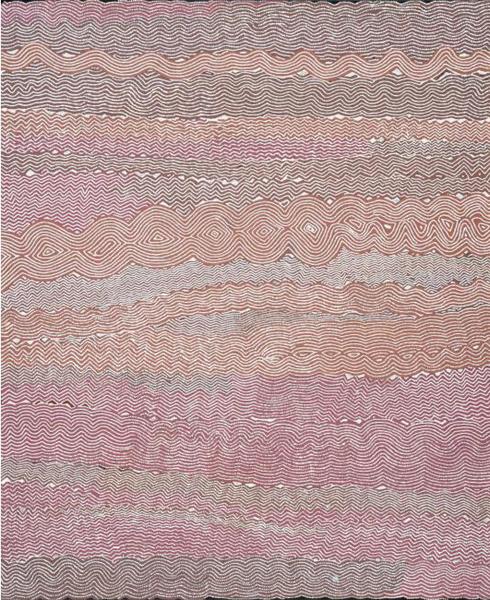
Bobby West Tjupurrula
Tingari Cycle (2002)
Synthetic polymer paint on Belgian linen
Image size:
120 cm x 92
cm
Framed size:
160 cm x
132 cm
Provenance:
Warumpi Community Art Centre
Price:
Enquire
Related work
Tingari Cycle
painted in 2002
is a
museum-quality original beautiful
painting
of impeccable
provenance
that has the sheer physical presence of
the much contemporary work of art.
Bobby West
Tjupurrula
work is in ‘The Lizard Eaters’ by
Douglas Lockwood.
The
Tingari
(Tingarri)
cycle Dreamtime
story
relate to the sacred sites around the Lake MacDonald area. These are
creation stories telling of the epic journey of the ancestors
spirits. The Tingari Men and Women
(ancestors),
travelled through the land in the Dreamtime (Tjukurrpa) created
sites and teaching Aboriginal law.
In
Australian Aboriginal mythology Tingari cycle
embodies a vast network of
Aboriginal
Dreaming (tjukurpa)
song-lines that pass through the Australian
Western Desert region. Locations and events
associated with the Tingari cycle are frequently the subject of
Aboriginal Art from the region.
Bobby West
father was Freddy West Tjakamarra, one of the original
shareholders of Papunya Tula Artists. Bobby was painting for Papunya
Tula Artists since the late 1980’s, and has become an integral part
of the company, serving also as chairman.
|
|
|
|
|
|
Auction Results
Auction Results
Bobby West
Tjupurrula
B.
1958
|
|
Details |
Price excl. GST |
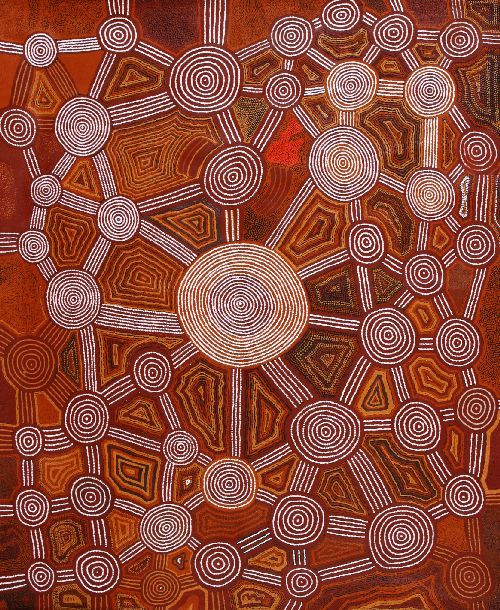 |
Tingari Cycle, 2002
Synthetic polymer paint on linen,
187 x 157 cm, Est: $18,000-22,000, Lawson~Menzies (now trading as
Menzies), Aboriginal Art Auction, Sydney, 23/11/2004, Lot No. 23
|
$18,600.00 |
 |
Yunala
2001
Synthetic polymer paint on linen, bears artists name, size and Papunya
Tula Artists catalogue number BW 0101012 on the reverse,
122 x 107 cm, Est: $15,000-20,000, Joel Fine Art, Aboriginal Art,
Melbourne, 03/06/2008, Lot No. 54
|
$18,300.00 |
 |
Untitled 2003
Synthetic polymer paint on linen, bears artist's name, size, Papunya
Tula Artists catalogue number BW0301182 on the reverse,
183 x 153 cm, Est: $15,000-20,000, Sotheby's, Important Aboriginal Art,
Melbourne, 24/07/2007, Lot No. 190 |
$18,000.00 |
For more information visit
http://www.aasd.com.au/
|
|
|
|
Bobby West
Tjupurrula
Biography
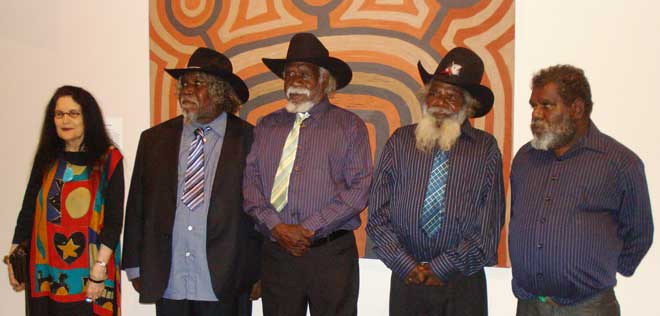
Papunya Tula artists at
the National Gallery of Victoria with curator Judith Ryan.
From left: Bobby West Tjupurrula, Long Jack Phillipus Tjakamarra, Ronnie
Tjampitjinpa and Mike Tjakamarra standing in front of a 1991 work by Ronnie
Tjampitjinpa, Wartunuma.
Bobby West
Tjupurrula
is
the son of Freddy West Tjupurrula, one of the original shareholders of
Papunya Tula Artist.
Bobby West
Tjupurrula biography
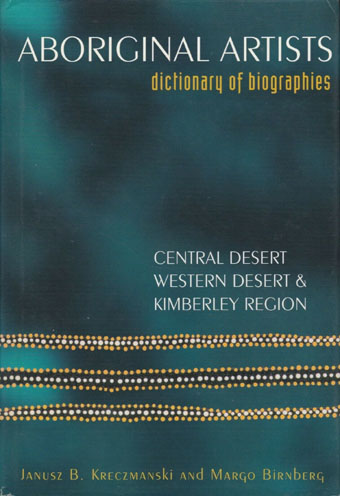
page 417, Aboriginal Artists dictionary of biographies.
Bobby West
Tjupurrula
was born circa 1958 at Rockhole site at Tjamu Tjamu which lies east of
Kiwirrkurra in Western Australia.
Bobby West
is the son of one of the original shareholders of Papunya Tula Artists,
Freddy West Tjakamarra
(1932-1994) who was one of the original painters for the Papunya Tula Artists.
Bobby West
is a traditional owner of Kiwirrkura and has been the official spokes
person for Papunya Tula.
Bobby
West Tjupurrula started painting for Papunya Tula Artists in the 1980s. He
has exhibited in 41 group shows, had a solo exhibition at William Mora
Galleries, Melbourne in 2002 and has work in 3 public collections at home and
abroad.
AWARDS
1999
men collaborative painting
depicting the
Tingari story
men from Kiwirkurra
and Balgo, was
purchased by
National
Museum
Berlin
in
Germany. (The other artists were
Jonny Yungut Tjupurrula, Kanya Tjapangati, Patric
Tjungurrayi, Tjumpo Tjapanangka and Walala Tjapangati).
2001 Bobby
West won
Alice Springs Art Award
2002
finalist the 19th Telstra
National Aboriginal and Torres Strait Islander Art Award
prior to winning the Telstra General Painting Award
2003
Art in Residency Fireworks Gallery
Brisbane.
2006
'Rising Stars' in
Gallery Gabrielle Pizzi Melbourne
2011
Art in Residency Fireworks Gallery
Brisbane
2011 Bobby West Tjupurrula won
2011
TELSTRA GENERAL PAINTING Art AWARD WINNER Telstra
General Painting Award in the 28th Telstra National Aboriginal and Torres Strait
Islander Art Award
Tjupurrula is from Kiwirrkura in Western Australia and painted a depiction of an
ancestral story from that region. The story tells of Tingari Men becoming
confronted by a large and fatal bushfire at the rockhole site of Tarkulnga.
The
announcement of winners took place in Darwin at the Museum and Art Gallery of
the Northern Territory Thursday 11 August 2011, the exhibition will run until 15
October 2011.
More at:
www.nt.gov.au/nreta/museums/exhibitions/natsiaa/
COLLECTIONS
Bobby West Tjupurrula
work is widely
acknowledged
in Australia and through the world
The National
Museum
Berlin
Kelton Foundation
California USA
Art Gallery of New South Wales
Royal Museum of Fine Arts Copenhagen
Denmark
Art Gallery South Australia
Museum and
Art Gallery of the Northern Territory
Northern Territory Museum of Arts and
Science
Queensland Art Gallery
Homes
a Court Collection
Art Bank Sydney
Art Gallery of Western Australia
Art Gallery of New South Wales
Works by
Bobby West Tjupurrula (1958– ) the Collection
of Art Gallery of NSW
By KIERAN FINNANE
A major exhibition on the origins of Western Desert art is set to open at the
Musee du Quai Branly in Paris in October. Curated by Judith Ryan and Philipp
Batty for the National Gallery of Victoria, Tjukurrtjanu opened in
Melbourne last year, examining “a watershed moment in the history of art when a
painting practice emerged at Papunya”. More than 160 of the first paintings
produced there during 1971 and 1972 will be shown in Paris, together with almost
100 objects and photographs from the period. The Musee du Quai Branly’s website,
describes the significance of the show thus: “By transposing to recycled wooden
panels the motifs employed in ephemeral ritual paintings, the Aborigine [sic]
artists of Papunya created an astonishingly inventive formal art, saturated with
meaning. These works change the manner of understanding the territory and
conceiving the history of Australian art.”
The Paris exhibition is just one of the events occurring in the second half of
this year that gives Papunya Tula Artists – the desert’s oldest painting company
and still the benchmark of independence and achievement – reason to be
optimistic.
Along with the entire art market, the company has been experiencing a “cooling
off”, says manager Paul Sweeney, but he sees it as a good thing. It has meant
fewer people out there chasing artists to churn out paintings, and this has
helped check the illusion in the minds of some artists “that everything they
painted was gold”. Only in “a very few cases” has that been true, he says.
The rate of production has slowed, from around 300 works a month at the height
of the market to a more manageable 100, yet there is still plenty of energy and
commitment amongst artists as well as keen interest in their work by art lovers
and collectors in Australia and around the world.
From hectic to just busy
The galleries that represent the company interstate were telling them “that
things were slowing down” well before they felt it in Alice Springs, says Mr
Sweeney. While the pace has now gone from “hectic to just busy” which is “kinda
nice”, the second half of the year is building to a certain tempo: “We’ve
definitely not gone into our shells. We’re still doing the same number of
shows.”
The celebrations to mark its 40th year will culminate with their annual show in
Alice Springs, on the last Friday of November, into which “we’ll pour
everything”, says Mr Sweeney. The Araluen Arts Centre will mark the occasion
with a parallel exhibition, reflecting on the relationship of the people of
Alice Springs with the company, showing works collected by locals over the
decades.

Dreamtime
Aboriginal people inherit stories
called “dreaming”. Each story may include songs, ceremonial
dances and rituals creating unique beliefs that the Aboriginal
people live by. All stories and beliefs are related to the land and
thus the land is great importance to them. The land is the keeper of
the stories and must be kept safe for all time so that the stories,
which are told in paintings, can be preserved. In modern
representation is the sacred aspect of painting is not always
completely revealed but the meaning, transmitted through symbols
remains, and can be understood.
Aboriginal people believe that the Universe was created by spirits
(mystical beings) setting the blueprint for all time the way human may
govern their conduct.
The spirits gathered their food, dug for water,
performing ceremonies as the Aboriginal do it today but the landscape
stay unchanged.
During the Creation Time spirits shaped all the
landscape; hills and water holes and given humans all the sacred laws.
That time was known as “Dreamtime” and it came to the end and their
ancestor changed into landscape, they turn into a rock or mountain
range, an isolated hill, river or even trees arose to mark the place.
Aboriginal people look upon these spirits creators as ancestors. Aboriginal believe
in an existing connection to their ancestor spirit and to the land. They
are spiritual biological beings appreciative of the fragility of the
nature and making an effort to live in harmony with the environment.
Since every Aboriginal descent of the mythical beings of the “Dreamtime”
each person is linked by myth and tribal relationship with the
landscape, the rocks and watercourses, and everything else in his tribal
country.
Aboriginal
Philosophy of life
The
philosophy of life, known as Dreamtime (Tjurrkurpa) is based on
tradition conceived by totemic ancestors. Men and women believe to be
direct descendants in spirit of “mythical architects” who created the
land and different totems; kangaroo, Emu, turkey, lizards and the land
in which they live.
Aboriginal
feel special affinity with their related totem
animal species.
It is
believed that sacred ceremonies have to be re-enacted on a regular basis
to maintain the animal species and ensure survival of the humans.
Each
family owns a special area of land and must protect sacred sites
representing their personal totems Dreamtime spirits. People travel long
distances from all directions to participate in the initiation
ceremonies and to educate the young. The journey could last days or
several months and women hunt and collect food during the voyage.
In mythological times a large
group of Tingari Men came from the rockhole site of Yunula west of
the Pollock Hills in Western Australia. They travelled east to
Kiwikurra and then further east passing through Pinari and onto
Warlukurlangu, south-east of the Yuendumu Community. The four arcs
represent men who were hit by hail-stones and are sitting recovering
Aboriginal
Secret
language
Concentric circle represents a
waterhole or a meeting place.
Oval
shape symbolize a coolamon
which is a
wooden bowl used to carry food, water and even babies.
Didgeridoo
originated from a northern part of Australia and it is a musical instrument
producing profound and remarkable rhythmic sound. It is made from a hollow small
tree or a branch of a tree eaten out by termites.
Music sticks
comprise of a pair wooden sticks and used in ceremonies as a common drumming
instrument to keep the rhythm of the song and dance and to accompany the
didgeridoo.
Boomerang
are made of mulga-wood and often used by men as a music drumming instrument for
ceremonies, there are some variation in length and thickness.
Returning
boomerangs
are mainly found in lake and swamp areas used traditionally
by men to scare birds from water ways into pre-nests.
Digging sticks are simple hardwood sticks with sharpen and fired harden point
mainly used by women for digging water, lizards, rabbits, witchetty
grubs and edible roots.
|
Literature
Source
& FURTHER
REFERENCES
Bobby West
Tjupurrula biography: page
417,
Aboriginal Artists: Dictionary of
Biographies: Central Desert, Western Desert and Kimberley Region
JB
Publishing Australia, Marleston, 2004,
Kreczmanski,
Janusz B and Birnberg, Margo
Aboriginal
Artists of the Western Desert - A Biographical Dictionary by Vivien
Johnson, published by Craftsman House 1994
The Oxford Companion to Aboriginal Art and Culture edited by Sylvia
Kleinert and Margo Neale published by OUP 2000
Aboriginal
Artists: Dictionary of Biographies: Central Desert, Western Desert &
Kimberley Region JB Publishing Australia, Marleston, 2004
Brody, A.
1989 Utopia women’s Paintings: the First Works on Canvas, A summer
Project, 1988-89 exhib. Cat. Heytesbury Holdings, Perth Brody
A. 1990
Utopia, a picture Story, 88 Silk Batiks from the Robert Homes a Court
Gallery and gallery Collection, Heytesbury Holdings LTD Perth NATSIVAD
database, Latz, P. 1995, Bushfires & Bushtucker, IAD Press, Alice
Springs
Brody, A.
1989 Utopia women’s Paintings: the First Works on Canvas, A summer
Project 1988-89 exhib. Cat. Heytesbury Holdings, Perth Brody
Amadio, N. und
Kimber, R., Wildbird Dreaming. Aboriginal Art from the Central Deserts
of Australia, Greenhouse Publ., Melbourne 1988; Auckland City Art
Gallery, Auckland 1990, Ausst. Kat.; Australian Aboriginal Art from the
Collection of Donald Kahn. Lowe Art Museum, University of Miami (Hrsg.),
1991, Ausst. Kat.; Droombeelden - Tjukurrpa. Groninger Museum (Hrsg.),
Groningen 1995, Ausst. Kat.; Isaacs, J., Australia´s Living Heritage.
Arts of the Dreaming, Lansdowne Press, Sydney 1984; Isaacs, J.,
Australian Aboriginal Paintings. Lansdowne, Sydney 1989, ISBN
186302011X; Johnson, V., Aboriginal Artists of the Western Desert. A
Biographical Dictionary, Craftsman House, East Roseville 1994, ISBN
9768097817; Modern Art - Ancient Icon. The Aboriginal Gallery of
Dreamings (Hrsg.), o.O. 1992, ISBN 0646080520; Nangara. The Australian
Aboriginal Art Exhibition from the Ebes Collection. The Aboriginal
Gallery of Dreamings (Hrsg.), Melbourne 1996, Ausst. Kat.; Stourton, P.
Corbally, Songlines and Dreamings. Lund Humphries Publ., London 1996,
ISBN 0853316910; The Painted Dream. Contemporary Aboriginal Paintings.
Johnson, V. (Hrsg.), Auckland City Art Gallery, Auckland 1991, Ausst.
Kat.; Tjinytjilpa. The Dotted Design. Aboriginal Art Galleries of
Australia (Hrsg.), Melbourne 1998, Ausst. Kat.; Traumzeit - Tjukurrpa.
Kunst der Aborigines der Western Desert. Die Donald Kahn-Sammlung,
Danzker, J.B. (Hrsg.), Prestel, München und New York 1994, Ausst. Kat.;
Voices of the Earth. Paintings, Photography and Sculpture from
Aboriginal Australia. Gabrielle Pizzi (Hrsg.), Gallery Gabrielle Pizzi,
Melbourne 1996, Ausst. Kat., ISBN 0646288954. |
RETURN TOP |
|
|

Galeria Aniela
provides an independent professional service
and experienced
guidance representing clients best interest in the art market.
We welcome the opportunity to speak with you, please feel free to
contact us to discuss
ways in which Galeria Aniela can assist you now and in the future.
Whether you are a first-time buyer, an astute investor or enthusiastic
collector, our people focused approach ensures an enjoyable and rewarding
experience.
video |
Galeria Aniela Fine Art broker
Combining a wide network of resources with
expertise in Australian fine art, we
assist clients in all aspects of
acquisitions of fine art objects,
shipping
worldwide,
ensuring impeccable
provenance
and quality,
helping save
time and
money.
Testimonials
Founded in 1994, Galeria Aniela exhibited world-class artists
and received celebrities including Sir David
Attenborough, Cameron
O’Reilly and
Hon Bob Hawke,
Australian Prime Minister.
Galeria Aniela
built
a
strong
standing
in Australia and internationally.
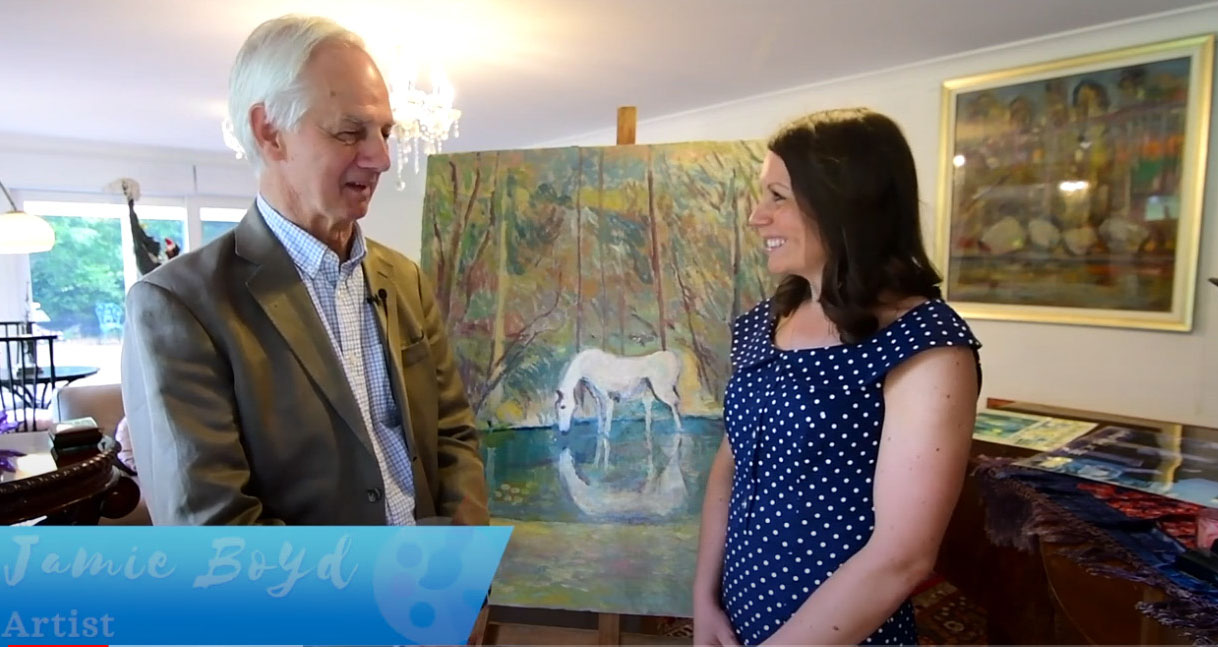
Video |Jamie Boyd, the Boyd
family most important LIVING artist
The
BOYD family
exhibition
in Galeria Aniela coup the
front page
Sydney Morning Herald,
Australian
National NEWS ABC TV
&
Sunday
Afternoon ABC TV.
John
Perceval Retrospective won
the Australian
National NEWS |ABC TV and
Charles
Blackman Retrospective conquer
Australian
Art Scream |SBS TV.
Works
of art live for generations, constantly reborn in the minds of the beholders to
bring new meanings, new dreams, new ways of seeing and experiencing the world.
Be part of this magic world of amazing fine art from the ocean of tranquillity
to
concur
the heart, mind and soul.
The vision of Galeria Aniela is to increase the awareness of Australian
artists
cultural contribution. Through hard work and dedication, in a peaceful manner,
we strive for high ideals to create a better future for the arts.
When you purchase Art from
Galeria Aniela,
you make a valuable contribution to our mission of helping artists to make a
living with their creations and together we make a difference.
|
|
|
|
|
|